Monday, September 12, 2011

Where's the bottom?

As stocks cratered Friday on renewed concerns over a Greek default, investors are undoubtedly asking, "Where's the bottom?"

I believe that investor sentiment is by no means at bearish extremes for a meaningful bottom to be put in at current levels. Bespoke recently conducted an (unscientific) poll that showed an excess of bulls.


The VIX Index, which is a measure of fear, has spiked. Readings are elevated but nowhere near either recent highs or Lehman Crisis extremes.


In addition, the Sep 7, 2011 reading on DAX investor sentiment shows an astounding level of 64% bulls and 20% bears. No capitulation here.


What's more, the violation of a significant technical support level for the euro is a signal that this decline is nowhere near an end.


Where's the technical support?
Given the current technical and sentiment backdrop, the S+P 500 is likely to violate its recent support level at 1100. The next logical support level is the 50% retracement at about 1020. The big question is, "Should Greece default, which would cause a banking crisis in Europe, would the 1020 level hold?"


Similarly, when I look at the Canadian market, the TSX is in a well-defined downtrend. Will the market hold at the 38% Fibonacci retracement level of 11650, the 50% retracement level of 10900, the 62% level of 10700, or does the market have to test the 2009 low?


Watching Europe
Rather than guessing, you have to go to the source and the source of any financial contagion comes from Europe. The key, then, is to watch the technical condition of European stocks.

The chart below of the STOXX 50 shows the index to be testing support at about the 2070 level. Should that not hold (and it likely won't in the event of a Greek default or banking crisis), the next logical stopping point is the 2009 lows at 1600 - which represents a decline of 24% from current levels.


A look at the point and figure chart of the STOXX 50 shows a downside projection of 1540 (circled in purple), a level that is close to the low seen in 2009.


In addition, this analysis from Brockhouse Cooper shows that European equities have less valuation support on a free cash flow or dividiend yield basis compared to other regional markets.


Moving from denial towards acceptance
The EU has been undergoing the classic stages of grief, which begins at denial and ends at acceptance. Last week, the finance minister of Estonia, a minor EU country, said that it was illogical to exclude the possibility of Greek bankruptcy (h/t Mish):
The economy minister of Estonia, member of the euro area since January, said it was “illogical” to exclude the possibility of bankruptcy, in an interview published Friday.

“I still do not understand how a failure to pay (heavily indebted countries) can be avoided,” said Juhan Parts in German daily Financial Times Deutschland. “In a market economy, this should be an option. It is illogical to want to avoid this issue,” he added.
More importantly, Bloomberg reported Friday that Germany was putting together contingency plans to insulate German banks and financials from the worse effects of a Greek default.
Chancellor Angela Merkel’s government is preparing plans to shore up German banks in the event that Greece fails to meet the terms of its aid package and defaults, three coalition officials said.

The emergency plan involves measures to help banks and insurers that face a possible 50 percent loss on their Greek bonds if the next tranche of Greece’s bailout is withheld, said the people, who spoke on condition of anonymity because the deliberations are being held in private. The successor to the German government’s bank-rescue fund introduced in 2008 might be enrolled to help recapitalize the banks, one of the people said.
It seems that a Greek default is virtually a done deal. A senior IMF economist was quoted as expecting a Greek default by March at the latest. Add to the equation the kind of finger pointing that happened at the G-7 meeting on the weekend: Eurozone blamed by US for world's economic plight. It is clear that the likelihood of coordinated intervention is off the table:
[I]nstead of the predicted economic debate, it emerged on Saturday that the bad-tempered meeting was dominated by American and British warnings that political failures and broken promises in the euro zone were in danger of triggering a wider crisis.

"Seventy-five per cent of the dark things happening in the world economy are because of the euro zone," said a senior US official after a round of talks ended in the early hours of yesterday morning.
Why do we want prolong this agony? Why not just rip off the band-aid and be done with it?
 
 
What to watch for
In the meantime, here is I am watching for as signs of a significant equity market bottom:
  • The behavior of European stocks. Will STOXX  hold at its 2009 lows or will it drop further?
  • Wait for the panic to show up in gold and gold stocks. During a panic liquidation, everything gets sold and the USD rallies. Will gold get liquidated in a "margin clerk" market? If not, I would expect at the very least the de-coupling of gold and gold stock prices - gold may rise, but gold stocks decline in sympathy with the broader equity indices.
  • Watch commodity prices and commodity currencies for signs of fear. In 2008, commodity prices cratered on the expectation that a global recession would result in lower commodity demand. This time around, commodity prices have been relatively firm. I would monitor the CRB Index, as well as commodity sennsitive currencies such as the Australian and Canadian Dollar for signs of panic.
  • Watch for credit spreads to blow out and bond index prices to turn negative. During the Lehman Crisis of 2008, bond indices, which included all bonds, turned negative while Treasuries rallied. Watch for a similar event by monitoring the relative performance of AGG against IEF. Right now, AGG (iShare Bond Index ETF) is underperforming IEF (7-10 year Treasury ETF) but levels are nowhere near the lows seen in 2008. Also watch the price of AGG to dip - but that ETF remains in rally mode and upward sloping for now.
Fasten your seatbelts. One day, you'll be able to tell your grandchildren, "I was there.".


Cam Hui is a portfolio manager at Qwest Investment Fund Management Ltd. ("Qwest"). This article is prepared by Mr. Hui as an outside business activity. As such, Qwest does not review or approve materials presented herein. The opinions and any recommendations expressed in this blog are those of the author and do not reflect the opinions or recommendations of Qwest.

None of the information or opinions expressed in this blog constitutes a solicitation for the purchase or sale of any security or other instrument. Nothing in this article constitutes investment advice and any recommendations that may be contained herein have not been based upon a consideration of the investment objectives, financial situation or particular needs of any specific recipient. Any purchase or sale activity in any securities or other instrument should be based upon your own analysis and conclusions. Past performance is not indicative of future results. Either Qwest or Mr. Hui may hold or control long or short positions in the securities or instruments mentioned.

Wednesday, September 7, 2011

Some financial innovations that aren't going to end well

Most of the time, innovation can be good. Other times, they have unintended side effects. This is especially true of financial innovations. Paul Volcker famously said that the banking's greatest innovation was the ATM.

I've never been an investment banker, but I was a research analyst once upon a time. (Yes, Virginia - Chinese walls do exist.) I do know enough about investment banking to know that it can be a very creative job. You spend a lot of time thinking of creative and innovative ways to get around regulations in order to get the deal done. That's how financial innovations get engineered.


Disintermediation in China
Here are a couple of examples of financial innovations that are not likely to end well. The Chinese authorities have been taking active steps to rein in bank lending by raising reserve ratios and interest rates. Recently, we have seen examples of disintermediation in China as a way of getting around restrictions on banking regulation. Patrick Chovanec explains:
According to Caixin, Chinese banks — limited in their ability to lend by China’s efforts to rein in inflation — have introduced a dizzying array of “private wealth management” (PWM) products aimed at higher-income investors.
These products are a way of getting around banking regulation by matching lenders with borrowers:
Why are Chinese banks suddenly so active in selling these products? One possibility is that they are simply an end-run around high reserve requirements. Instead of struggling to gather deposits (at less and less attractive interest rates) and then setting aside 21.5% as cash reserves before lending the rest out, banks can promise high interest rates and channel the whole amount directly into lending, collecting a fee instead of a spread.
The other possibility is that PWM funds provide a way for banks to shift growing lending risks onto customers. Rather than underwriting loans, they’re playing matchmaker. In some cases, critics fear, banks may have a conflict of interest, and may actually be shifting not just risk but known losses onto naive investors. For instance, if bank helps a local government sell bonds in order to repay its troubled bank debt, it can offload its problem debts onto its clients.
Tracy Alloway at FT Alphaville wrote that Chinese companies are also getting into the act. She quotes a Standard Chartered research report:
In City X, something slightly different is happening, which we suspect is being repeated in cities across the country. We found that a couple of large local state-owned firms whose main business was not finance are now expanding into operating guarantee companies, pawnshops, trusts, etc. We surmise that they are doing so with the support of large surplus cash earned by the group’s (often monopoly) activities, or with funds easily borrowed by the parent group from friendly banks. It appeared that at least some of their business was based on their ability to borrow funds at 7-8%, and then on-lend at rates of 20-30%, arbitraging the dual-interest rate environment. They would also in theory be free to funnel funds borrowed for one purpose into, say, real estate.

We find this disturbing for a number of reasons:

  • The state already dominates much of the financial sector, but areas like GCs and small loan companies open a window to private-sector activity. Local SOEs now look set to dominate these new parts of the financial sector too.
  • Such platforms combine industrial and financial functions within the same group. This introduces new risks, since it facilitates fund flows that fall outside of regulators’ monitoring. It also adds a new transmission mechanism for bad credit problems to spread through the economy.
  • These platforms also broaden the scope for corruption at firms with low levels of government oversight.
There are times when government regulation inhibits economic activity. At other times, they are meant to minimize systemic risk by avoiding the moral hazard problem. This is one of the instances of the latter. Chovanec commented that disintermediation can makes the system more opaque. If this unravels, then how do you unscramble an omelette?
The most alarming part of the story, however, is how banks have been rolling over and pooling short-term, high-return funds in a way that makes it very difficult to trace how, exactly, investors are being paid off.
If this blows up, some people are going to get bullets in the backs of their heads.

The collateral swap
Another example of financial innovation is the collateral swap. Izabella Kaminska of FT Alphaville explains the mechanics [emphasis added]:
A collateral swap is essentially a form of secured lending whereby one counterparty transfers relatively liquid assets to another in exchange for a pledge of less liquid collateral. In a typical collateral swap, a bank holding a portfolio of ABS or other securitizations will transfer these assets to a pension fund or insurance company which, in exchange for a periodic fee, will deliver a portfolio of more liquid collateral such as high-grade government or corporate bonds.

The pension fund or insurer thereby receives a higher yield on its (ostensibly) safe investments, while the bank obtains access to a portfolio of liquid assets which it can then re-pledge to obtain funding from central banks and other sources which, in the wake of the GFC, have been less willing to accept ABS and other securitizations as eligible collateral. The development of collateral swaps is thus, in effect, an innovative response to both the post-crisis funding constraints on banks and the need to satisfy new liquidity requirements soon to be imposed under Basel III.
The immediate benefit to the investor (pension fund, insurer, etc.) is a higher yield on its investments. It's fully collateralized, right??? The bank gets higher quality paper to satisfy Basel III requirements and, in the event of a liquidity squeeze, to pledge to a central bank such as the ECB or BoE.

Everybody wins! Right?

The Ray DeVoe quip still applies today, "More money has been lost reaching for yield than at the point of a gun." Here are the risks:
Collateral swaps contribute to the complexity of modern financial markets in at least three ways. First, the collateral swap market is extremely opaque. Nobody knows with any certainty, for example, how big this market is, who the major players are, or the size of the aggregate exposures. As a result, it is exceedingly difficult to ascertain the nature and extent of the attendant risks. Second, given the identity of the counterparties, collateral swaps seem destined to strengthen the interconnections between (1) banking markets and (2) insurance and pension markets. Finally, as described above, collateral swaps are a reflexive response to changes in the post-crisis market and regulatory environment.
 

An accident waiting to happen
Given the heightened level of systemic risk in the financial system, these developments can only be viewed as disturbing. In my first example of disintermediation in China, it suggests that a shadow banking system is forming in China and control of the banking system is slipping away from the Chinese authorities.

In the second case, it suggests that a number of institutions could get hurt should a banking crisis erupt in Europe. They will have to read the legal language of those swap agreements very, very carefully in order to limit their exposure.

Something tells me that this isn't going to end well. This is one of those times when the markets really needs some adult supervision and we can't all walk around with the attitude that risk management is for pu**ies.


Cam Hui is a portfolio manager at Qwest Investment Fund Management Ltd. ("Qwest"). This article is prepared by Mr. Hui as an outside business activity. As such, Qwest does not review or approve materials presented herein. The opinions and any recommendations expressed in this blog are those of the author and do not reflect the opinions or recommendations of Qwest.

None of the information or opinions expressed in this blog constitutes a solicitation for the purchase or sale of any security or other instrument. Nothing in this article constitutes investment advice and any recommendations that may be contained herein have not been based upon a consideration of the investment objectives, financial situation or particular needs of any specific recipient. Any purchase or sale activity in any securities or other instrument should be based upon your own analysis and conclusions. Past performance is not indicative of future results. Either Qwest or Mr. Hui may hold or control long or short positions in the securities or instruments mentioned.

Tuesday, September 6, 2011

Super-Twist: Ben's secret weapon?

At the Jackson Hole meeting, Fed Chairman Ben Bernanke said, in effect, that he has some secret weapon(s) that they FOMC would discuss at its September meeting [emphasis added]:
In addition to refining our forward guidance, the Federal Reserve has a range of tools that could be used to provide additional monetary stimulus. We discussed the relative merits and costs of such tools at our August meeting. We will continue to consider those and other pertinent issues, including of course economic and financial developments, at our meeting in September, which has been scheduled for two days (the 20th and the 21st) instead of one to allow a fuller discussion. The Committee will continue to assess the economic outlook in light of incoming information and is prepared to employ its tools as appropriate to promote a stronger economic recovery in a context of price stability.
Since he didn't specify what the "range of tools" were, they might be "secret weapons" of monetary stimulus. What could they be?


Super-Twist?
One of the much anticipated tools is a repeat of "Operation Twist", a Kennedy Administration plan to flatten the yield curve by buying longer maturity bonds in order to push down long term yields. The San Franciso Fed explains:
The Kennedy Administration’s proposed solution to this dilemma was to try to lower longer-term interest rates while keeping short-term interest rates unchanged—an initiative now known as “Operation Twist” in homage to the dance craze then sweeping the nation. The idea was that business investment and housing demand were primarily determined by longer-term interest rates, while cross-currency arbitrage was primarily determined by short-term interest rate differentials across countries. Policymakers reasoned that, if longer-term interest rates could be lowered without affecting short-term yields, the weak U.S. economy could be stimulated without worsening the outflow of gold.
This move has been so well telegraphed that Bill Gross announced that Pimco was extending the maturity of its portfolio.

What if there's more? Bruce Krasting provided a clue in this recent post. He speculated that Obama Administration is going to propose a gigantic refi program. If homeowners pay off their mortgages and refinance, that will create tremendous cash flows to MBS holders. The Fed happens to hold about $1T in MBS and all these pre-payments will give the Fed money to do an Operation Twist and buy in the long end of the curve without expanding their balance sheet. If they hold $1T in MBS and pre-pays are sufficiently high, then the program will be QE2 sized.

My first reaction was, "Wow! This is a form of Operation Twist on steroids - a sort of Super-Twist. Another QE2 sized purchase of Treasury bonds in the long end of the curve!" This would spark a QE2-style rally in risky assets.
 
Upon some more sober reflection, I realized that there are major drawbacks to this scheme inasmuch it is unlikely to have a significant effect on asset prices. First of all, major MBS holders are Fannie, Freddie and the Fed (3F). Most mortgage backed securities are priced at a premium and this re-fi program will pay investors off at par. Thus, 3F will be taking a substantial loss on their holdings.
 
There is another problem. Suppose that this re-fi program generates $X billion in pre-payments which get re-financed. Then $X billion of MBS supply will come back into the market. One of the ways that QE2 pushed up asset prices was because it ballooned the Fed balance sheet by pushing a wall of liquidity out into the market. This program is more of a variation of Operation Twist, which extends the Fed balance sheet out to the longer end of the yield curve, but at a cost. Depending on how it's implemented, I could see substantial movement in credit spreads but don't expect QE2-like effects.

Moreover, it isn't clear to me what the sustainable benefits there to flattening the yield curve. The last FOMC meeting statement indicating that rates would stay low for another two years encouraged financial institutions to get long the carry trade of borrowing short and lending long. An Operation Twist, or Super-Twist, that flattens the yield curve undoes some of those benefits - though it does provide an immediate boost to investors who are already positioned in the longer end of the Treasury curve.
 
I suppose that the market could focus on the fact that $X billion is available to the Fed to re-deploy on its balance sheet, which would be bullish. On the other hand, it could also decide that this program is net neutral to negative because of the costs involved.
 
If Super-Twist is indeed the major weapons in Bernanke's stash of "secret weapons", I am unimpressed and I bet that the bulls will be unimpressed as well.


Cam Hui is a portfolio manager at Qwest Investment Fund Management Ltd. ("Qwest"). This article is prepared by Mr. Hui as an outside business activity. As such, Qwest does not review or approve materials presented herein. The opinions and any recommendations expressed in this blog are those of the author and do not reflect the opinions or recommendations of Qwest.

None of the information or opinions expressed in this blog constitutes a solicitation for the purchase or sale of any security or other instrument. Nothing in this article constitutes investment advice and any recommendations that may be contained herein have not been based upon a consideration of the investment objectives, financial situation or particular needs of any specific recipient. Any purchase or sale activity in any securities or other instrument should be based upon your own analysis and conclusions. Past performance is not indicative of future results. Either Qwest or Mr. Hui may hold or control long or short positions in the securities or instruments mentioned.

Monday, September 5, 2011

Why Germany should leave the eurozone (in pictures)

Everyone knows that Italian yield spreads against Bunds have been blowing out:

10-Year Italian bond yields vs. 10-year Bunds.

I thought that I would look at the long-term performance of the other major eurozone stock markets against the DAX. Here is Italy, which is a bellwether for stress within the eurozone. It's been in a relative downtrend since 2005 and there are no indications that there is any bottom. The downtrend has been steady, well-defined and not oversold on RSI.


What about the other major partner, France? Oh, never mind...


How about other "hard" currency countries, like the Netherlands?


The one "silver lining" in this analysis has been the performance of Spain's IBEX 35 against the DAX, which has appeared to have rallied out of its relative downtrend.


How much longer can Germany carry the rest of the eurozone?


Cam Hui is a portfolio manager at Qwest Investment Fund Management Ltd. ("Qwest"). This article is prepared by Mr. Hui as an outside business activity. As such, Qwest does not review or approve materials presented herein. The opinions and any recommendations expressed in this blog are those of the author and do not reflect the opinions or recommendations of Qwest.

None of the information or opinions expressed in this blog constitutes a solicitation for the purchase or sale of any security or other instrument. Nothing in this article constitutes investment advice and any recommendations that may be contained herein have not been based upon a consideration of the investment objectives, financial situation or particular needs of any specific recipient. Any purchase or sale activity in any securities or other instrument should be based upon your own analysis and conclusions. Past performance is not indicative of future results. Either Qwest or Mr. Hui may hold or control long or short positions in the securities or instruments mentioned.

One-eyed men (who would be kings)

As events turned south in Greece on Friday, the WSJ reported that a senior IMF economist expected a Greek default before March:
"I expect a hard default definitely before March, maybe this year, and it could come with this program review," said a senior IMF economist who is keeping close tabs on the situation. "The chances for a second program are slim."
Furthermore, the Greek bailout was dealt a blow as Angela Merkel's CDU was soundly defeated in local elections over the weekend.

As investors look for safe havens in a potential market panic, I am reminded of the adage, "In the land of the blind, the one-eyed man is king."

Today, I see several metaphorical one-eyed men in this land of the blind that could serve as safe havens were there to be a market panic. All of them have significant flaws. In this post I would like to discuss them one by one.


US Treasury bonds
US Treasuries remain my favorite safe haven play and they have significant upside potential in the event of a market meltdown. The long Treasury ETF staged an upside breakout to all-time highs on Friday, surpassing the levels seen during the Lehman Crisis - a bullish sign.


My reservation about Treasury bonds is that the US has long-term fiscal problems. In such a case, can bonds be really a safe haven?


Gold
The price of gold has been on a tear since the market bottomed in March 2009.


Gold stocks staged an upside breakout to all-time highs on Friday, which I interpret as being bullish for bullion. Longer term, I still favor holding gold over gold stocks.


My principal reservation about gold is that it generally hasn't held up well in a market panic. It didn't during the Lehman Crisis of 2008. It sold off during the mini-panic earlier this year after the Japanese earthquake.

Despite what the gold-bugs say, gold and commodities have traditionally been part of the "risk-on" trade. In a "risk-off" market panic, risk managers and margin clerks control the market. They demand that traders and investors liquidate positions in order to meet their risk criteria and meet margin calls on all of their positions. That's why correlations converge to 1 during these market selloff episodes. One sign that I would watch for as a "tell" of a "margin clerk market" might be that gold stocks will de-couple from the price of gold. While gold may go up as a safe haven during such an episode, gold stocks may sell off because the risk managers regard them as stocks first and gold the alternative currency second.

In the current environment, I am inclined to give gold the benefit of the as a safe haven given its recent history of rising during this period of fear. I would not be inclined, however, to give the same benefit of doubt to other hard asset commodities. If there were to be a market selloff because of the fear of a recession or a banking crisis which would plunge the world into a global recession, don't you think that global demand for copper, oil and other economically sensitive commodities would fall as well?


Swiss Franc
The Swissie has been rising in the current environment of fear. As the chart below shows, CHF has been in a well-defined uptrend.


My reservations about the Swiss one-eyed man is twofold. Firstly, it didn't serve well as a safe haven during the crisis in 2008. Second, were Europe to blow up because of a banking crisis, does anyone really think that the Swiss banks won't escape collateral damage? Just look at this chart of Swiss bank asset to home country GDP exposure.


We want a vehicle that will hold up well in a market meltdown. The CHF strikes out in my book.

Incidentally, the Japanese Yen has also rallied during these turbulent periods and some investors have regarded JPY as a possible safe haven in a crisis. But I have observed how the BoJ (cough) "manages" JPY levels and there is too high a risk of intervention. JPY levels is overly "managed" in my book to qualify as a true safe haven in a crisis.


The winners are...
In summary, I would look at the following two vehicles as safe havens in a crisis (in order of preference):
  1. US Treasury bonds (long Treasuries if you want to be aggressive);
  2. Gold, but avoid gold stocks.
I would avoid currencies such as CHF and JPY because of specific problems connected with those countries or currencies.


Cam Hui is a portfolio manager at Qwest Investment Fund Management Ltd. ("Qwest"). This article is prepared by Mr. Hui as an outside business activity. As such, Qwest does not review or approve materials presented herein. The opinions and any recommendations expressed in this blog are those of the author and do not reflect the opinions or recommendations of Qwest.

None of the information or opinions expressed in this blog constitutes a solicitation for the purchase or sale of any security or other instrument. Nothing in this article constitutes investment advice and any recommendations that may be contained herein have not been based upon a consideration of the investment objectives, financial situation or particular needs of any specific recipient. Any purchase or sale activity in any securities or other instrument should be based upon your own analysis and conclusions. Past performance is not indicative of future results. Either Qwest or Mr. Hui may hold or control long or short positions in the securities or instruments mentioned.

Friday, September 2, 2011

No help from the banks for the bulls

I have been writing about the relative performance of the KBW Bank Index (BKX) relative to the market since May. I indicated that a relative breakdown of the BKX against the market was an indication of rising systemic risk, consistent with a Russia Crisis or Lehman Crisis. Since then, the relative breakdown did take place and things have gotten worse, a lot worse.

Despite a half-hearted rally from the Berkshire/BAC deal, the banks remain in a relative downtrend against the market.


Up until recently, the performance of the Regional Banks have been relatively well behaved. While the BKX, which is heavily weighted with Too-Big-To-Fail (TBTF) banks, had broken down on a relative basis, the Regional Bank Index had held steady. Now the Regionals have broken down and they are having trouble rallying above relative resistance.


FT Alphaville has been writing extensively about the short-term funding problems of European banks because of the withdrawal of money market funds from the eurozone banking market (example here), now it appears that the French banks are having trouble because of their heavy reliance on wholesale funding.

Look at this chart of the ratio of the Euro STOXX Banks vs. the EURO STOXX Index. The Europeans banks are in a relative downtrend and they have broken a major relative support line. The relative ratio is now at all time lows - a sign of trouble.


Signs of systemic risk are rising. Take a look at this chart of funding costs of various banks. Eeek!


How many bullets can you dodge?
Putting all this together, I interpret these conditions as:
  • Systemic risk in the US banking system: The US TBTF banks are signaling rising systemic risk.
  • High risk of a US recession: The relative weakness of the US Regional Banks is signaling a high risk of a US recession.
  • Lehman/Russia Crisis warning in Europe: The combination of continuing stories of short-term funding problems at eurozone banks and the relative breakdown of that sector in Europe are signaling a very serious problem. No wonder IMF Managing Director Christine Lagarde warned at Jackson Hole that European "banks need urgent recapitalization."
Maybe the combination of the Fed, ECB, the Obama Administration, Congress and the EU can get together and kick the can down the road yet one more time.

Realistically though, how many bullets can you really dodge? With risks like these on the horizon and technical indications that the bulls are losing control, I would be inclined to stay long the US long bond.


Cam Hui is a portfolio manager at Qwest Investment Fund Management Ltd. ("Qwest"). This article is prepared by Mr. Hui as an outside business activity. As such, Qwest does not review or approve materials presented herein. The opinions and any recommendations expressed in this blog are those of the author and do not reflect the opinions or recommendations of Qwest.

None of the information or opinions expressed in this blog constitutes a solicitation for the purchase or sale of any security or other instrument. Nothing in this article constitutes investment advice and any recommendations that may be contained herein have not been based upon a consideration of the investment objectives, financial situation or particular needs of any specific recipient. Any purchase or sale activity in any securities or other instrument should be based upon your own analysis and conclusions. Past performance is not indicative of future results. Either Qwest or Mr. Hui may hold or control long or short positions in the securities or instruments mentioned.

Thursday, September 1, 2011

Seeds of a revolution

I have written extensively about the widening income gap between the rich and poor in America. For examples, see:
  1. Which is more elitist? France or America?
  2. It's a Class War, Stupid!
  3. The Fed's (inadvertent) role in the class war
A number of mainstream figures have jumped on that bandwagon. Consider this article from the Washington Post from June that decried the filthy rich:
It was the 1970s, and the chief executive of a leading U.S. dairy company, Kenneth J. Douglas, lived the good life. He earned the equivalent of about $1 million today. He and his family moved from a three-bedroom home to a four-bedroom home, about a half-mile away, in River Forest, Ill., an upscale Chicago suburb. He joined a country club. The company gave him a Cadillac. The money was good enough, in fact, that he sometimes turned down raises. He said making too much was bad for morale.

Forty years later, the trappings at the top of Dean Foods, as at most U.S. big companies, are more lavish. The current chief executive, Gregg L. Engles, averages 10 times as much in compensation as Douglas did, or about $10 million in a typical year. He owns a $6 million home in an elite suburb of Dallas and 64 acres near Vail, Colo., an area he frequently visits. He belongs to as many as four golf clubs at a time — two in Texas and two in Colorado. While Douglas’s office sat on the second floor of a milk distribution center, Engles’s stylish new headquarters occupies the top nine floors of a 41-story Dallas office tower. When Engles leaves town, he takes the company’s $10 million Challenger 604 jet, which is largely dedicated to his needs, both business and personal.
Henry Blodgett recently wrote Remember "The American Dream?" What A Bunch Of Crap where he decried the lack of opportunity in America by pointing to the correlation of intergenerational earnings, which is a point that I made some time ago by referencing an OECD study that came to the same conclusion.


Now Bill Gross, who can hardly be characterized as a pinko commie, lamented the death of the American Dream in his latest missive [emphasis added]:
This impending divorce in America is not about sex or sleeping around, but more about romancing the now stone-cold notion that anyone could be a millionaire in the good old U.S. of A. if only they worked hard enough. Our Statue of Liberty proclaimed “give us your tired, your poor…” and sent many of them West to build a little house on the prairie or strike it rich in the goldfields of Sacramento, California or Skagway, Alaska. Many of them did and a century later, the option-laden fields of Silicon Valley provided modern-day examples of rags to riches fairytales come true. But this odd couple marriage of rich (and poor hoping to be rich), now seems on rather shaky ground. Instead of boundless opportunity, the nursery rhyme describing Jack Sprat – who could eat no fat – and his wife – who could eat no lean – appears to be the starker of the two realities. There are the poor and there are the very rich, with the shrinking middle class resembling Mr. Sprat rather than his wife.
How Wall Street owns America
The truth is that the top 0.1% really controls most of the wealth in American and even the merely affluent are just making do. Consider this commentary from an experienced wealth management professional. Here is his characterization of the bottom of the top 1% in America today - these are your Horatio Alger stories:
The 99th to 99.5th percentiles largely include physicians, attorneys, upper middle management, and small business people who have done well.
Those in the bottom half of the top 1% are actually rather insecure and not exactly living the life of the rich and famous [emphasis added]:
I’ve had many discussions in the last few years with clients with “only” $5M or under in assets, those in the 99th to 99.9th percentiles, as to whether they have enough money to retire or stay retired. That may sound strange to the 99% not in this group but generally accepted “safe” retirement distribution rates for a 30 year period are in the 3-5% range with 4% as the current industry standard. Assuming that the lower end of the top 1% has, say, $1.2M in investment assets, their retirement income will be about $50k per year plus maybe $30k-$40k from Social Security, so let’s say $90k per year pre-tax and $75-$80k post-tax if they wish to plan for 30 years of withdrawals. For those with $1.8M in retirement assets, that rises to around $120-150k pretax per year and around $100k after tax. If someone retires with $5M today, roughly the beginning rung for entry into the top 0.1%, they can reasonably expect an income of $240k pretax and around $190k post tax, including Social Security.

While income and lifestyle are all relative, an after-tax income between $6.6k and $8.3k per month today will hardly buy the fantasy lifestyles that Americans see on TV and would consider “rich”. In many areas in California or the East Coast, this positions one squarely in the hard working upper-middle class, and strict budgeting will be essential. An income of $190k post tax or $15.8k per month will certainly buy a nice lifestyle but is far from rich. And, for those folks who made enough to accumulate this much wealth during their working years, the reduction in income and lifestyle during retirement can be stressful. Plus, watching retirement accounts deplete over time isn’t fun, not to mention the ever-fluctuating value of these accounts and the desire of many to leave a substantial inheritance. Our poor lower half of the top 1% lives well but has some financial worries.
People who are in the top 0.1% or 0.5% generally got their wealth from finance [emphasis added]:
Folks in the top 0.1% come from many backgrounds but it’s infrequent to meet one whose wealth wasn’t acquired through direct or indirect participation in the financial and banking industries. One of our clients, net worth in the $60M range, built a small company and was acquired with stock from a multi-national. Stock is often called a “paper” asset. Another client, CEO of a medium-cap tech company, retired with a net worth in the $70M range. The bulk of any CEO’s wealth comes from stock, not income, and incomes are also very high. Last year, the average S&P 500 CEO made $9M in all forms of compensation. One client runs a division of a major international investment bank, net worth in the $30M range and most of the profits from his division flow directly or indirectly from the public sector, the taxpayer. Another client with a net worth in the $10M range is the ex-wife of a managing director of a major investment bank, while another was able to amass $12M after taxes by her early thirties from stock options as a high level programmer in a successful IT company. The picture is clear; entry into the top 0.5% and, particularly, the top 0.1% is usually the result of some association with the financial industry and its creations. I find it questionable as to whether the majority in this group actually adds value or simply diverts value from the US economy and business into its pockets and the pockets of the uber-wealthy who hire them. They are, of course, doing nothing illegal.

You need intellectuals and leaders for a revolution
History is filled with peasant revolutions that fizzled and never went anywhere. The ones that are really dangerous to the Ruling Powers are the movements that have 1) leadership; 2) followers; and 3) an intellectual foundation. It may be easy to dismiss the likes of left leaning DailyKos account of Iceland's ongoing revolution, which is the modern equivalent of peasants gathering with pitchforks. It's more difficult when establishment figures like Bill Gross and Warren Buffett stands up for the cause.
 
In addition, we also have George Magnus, of UBS, who has writing an editorial in that pinko website Bloomberg entitled Give Karl Marx a chance to save the world economy. The likes of Gross, Buffett, Magnus et al represent the leadership in this movement to save capitalism from itself. If they aren't careful, they may spark a revolution that goes in an unintended direction. (For example, remember Gorbachev? Where is he now?)
 
What about the intellectual foundation for a revolution? I found an intriguing and disturbing interview with David Graeber, a social anthropologist, who has a new theory of money - that the use of debt and credit is a way to creating a class of debt slaves. He explains that credit came first before currency as a medium of exchange:
So really, rather than the standard story – first there’s barter, then money, then finally credit comes out of that – if anything its precisely the other way around. Credit and debt comes first, then coinage emerges thousands of years later and then, when you do find “I’ll give you twenty chickens for that cow” type of barter systems, it’s usually when there used to be cash markets, but for some reason – as in Russia, for example, in 1998 – the currency collapses or disappears.
Even in ancient Mesopotamia, there were debt slaves [emphasis added]:
This was the great social evil of antiquity – families would have to start pawning off their flocks, fields and before long, their wives and children would be taken off into debt peonage. Often people would start abandoning the cities entirely, joining semi-nomadic bands, threatening to come back in force and overturn the existing order entirely. Rulers would regularly conclude the only way to prevent complete social breakdown was to declare a clean slate or ‘washing of the tablets,’ they’d cancel all consumer debt and just start over. In fact, the first recorded word for ‘freedom’ in any human language is the Sumerian amargi, a word for debt-freedom, and by extension freedom more generally, which literally means ‘return to mother,’ since when they declared a clean slate, all the debt peons would get to go home.
Graeber said that the idea of debt is deeply embedded in the language of ancient cultures and religions:
In Sanskrit, Hebrew, Aramaic, ‘debt,’ ‘guilt,’ and ‘sin’ are actually the same word. Much of the language of the great religious movements – reckoning, redemption, karmic accounting and the like – are drawn from the language of ancient finance.
Throughout history, we have seen shifts between a credit based economy and commodity/barter based economies, but those shifts are highly disruptive and can cause the fall of civilizations:
Since antiquity the worst-case scenario that everyone felt would lead to total social breakdown was a major debt crisis; ordinary people would become so indebted to the top one or two percent of the population that they would start selling family members into slavery, or eventually, even themselves.
Top one or two percent? Sound familiar? He went on to talk about how the financial institutions are now perpetuating the status quo [emphasis added]:

Well, what happened this time around? Instead of creating some sort of overarching institution to protect debtors, they create these grandiose, world-scale institutions like the IMF or S&P to protect creditors. They essentially declare (in defiance of all traditional economic logic) that no debtor should ever be allowed to default. Needless to say the result is catastrophic. We are experiencing something that to me, at least, looks exactly like what the ancients were most afraid of: a population of debtors skating at the edge of disaster.
And, I might add, if Aristotle were around today, I very much doubt he would think that the distinction between renting yourself or members of your family out to work and selling yourself or members of your family to work was more than a legal nicety. He’d probably conclude that most Americans were, for all intents and purposes, slaves.
Remember that quote, "[Aristotle] would probably conclude that most Americans were, for all intents and purposes, slaves."

The American Revolution was sparked by the theory of natural rights, as espoused by thinkers such as John Locke. Today, Graeber may fill the role of Locke. We have all the ingredients for a revolutions: the intellectual foundation (a new theory of money that concludes that Americans are debt slaves), a leadership cadre (Buffett, Gross, Magnus et al) and dissatisfied peasants with pitchforks.

America needs to be careful. Down that road is Robespierre, Hitler and the disintegration of a civilization.


Cam Hui is a portfolio manager at Qwest Investment Fund Management Ltd. ("Qwest"). This article is prepared by Mr. Hui as an outside business activity. As such, Qwest does not review or approve materials presented herein. The opinions and any recommendations expressed in this blog are those of the author and do not reflect the opinions or recommendations of Qwest.


None of the information or opinions expressed in this blog constitutes a solicitation for the purchase or sale of any security or other instrument. Nothing in this article constitutes investment advice and any recommendations that may be contained herein have not been based upon a consideration of the investment objectives, financial situation or particular needs of any specific recipient. Any purchase or sale activity in any securities or other instrument should be based upon your own analysis and conclusions. Past performance is not indicative of future results. Either Qwest or Mr. Hui may hold or control long or short positions in the securities or instruments mentioned.

Wednesday, August 31, 2011

Where's the technical confirmation?

I was rummaging through my desk and found the following article from Investors Business Daily written on September 27, 2001, which was shortly after the 9/11 attack and market selloff (sorry no link). The article details the follow-through day pattern popularized by William O'Neill as a way of spotting intermediate term bottoms:
[Y]ou’ll want to see a market confirmation.
That starts when one of the three major indexes begins to rally. That’s day one. Next, wait two days. The market often needs time to digest its initial gains. Make sure the index doesn’t undercut its low. If it does, start counting over again.

Starting on day four of the cycle, look for a follow-through session. That occurs when the Dow, Nasdaq or S+P 500 jumps at least 2% on higher volume than the previous day. Ideally trade will also exceed its 50-day average. The bigger the price and volume moves, the better.

The strongest follow-throughs occur between days four and seven of the attempted rally. Follow-throughs after the 10th day become less significant.
How does it apply to the current market? A number of technicians have turned bullish and called this a W-bottom. Bespoke has published a comparison of the 2010 and 2011 market by popular request:


With that in mind, let's look at the market pattern using the O'Neill follow-through criteria. Here are the charts for the major average ETFs. First, let's look at SPY. Day 1 of the rally, according to the above, was August 23. On August 29 (day 5), we had a rally of over 2%, but it was not on "higher volume than the previous day".
 
 
What about the NASDAQ? Here is the chart of QQQ, which shows a similar pattern of a low volume rally on August 29.
 
 
Ditto for IWM, which is the Russell 2000 ETF:
 

The SPY just kissed the bottom of the Fibonacci retracement level on this rally today (Wednesday). As you can see from the RSI chart on top, this market is no longer oversold but sport a neutral reading on RSI. Given these non-confirmations, I would at least be hesitant to go long here but regard the current levels as an opportunity to lighten positions.


Cam Hui is a portfolio manager at Qwest Investment Fund Management Ltd. ("Qwest"). This article is prepared by Mr. Hui as an outside business activity. As such, Qwest does not review or approve materials presented herein. The opinions and any recommendations expressed in this blog are those of the author and do not reflect the opinions or recommendations of Qwest.


None of the information or opinions expressed in this blog constitutes a solicitation for the purchase or sale of any security or other instrument. Nothing in this article constitutes investment advice and any recommendations that may be contained herein have not been based upon a consideration of the investment objectives, financial situation or particular needs of any specific recipient. Any purchase or sale activity in any securities or other instrument should be based upon your own analysis and conclusions. Past performance is not indicative of future results. Either Qwest or Mr. Hui may hold or control long or short positions in the securities or instruments mentioned.

Tuesday, August 30, 2011

Things aren't adding up for bulls

Despite the big rally in stocks on Monday, some things aren't quite adding up for me. Let's discuss the problem regions one by one: the United States and Europe.


A looming US recession
A market analyst would have to be in hibernation to know that strategists have raising their probability of a recession. John Hussman believes that either one is inevitable or we are already in a recession [emphasis added]:
It is now urgent for investors to recognize that the set of economic evidence we observe reflects a unique signature of recessions comprising deterioration in financial and economic measures that is always and only observed during or immediately prior to U.S. recessions. These include a widening of credit spreads on corporate debt versus 6 months prior, the S&P 500 below its level of 6 months prior, the Treasury yield curve flatter than 2.5% (10-year minus 3-month), year-over-year GDP growth below 2%, ISM Purchasing Managers Index below 54, year-over-year growth in total nonfarm payrolls below 1%, as well as important corroborating indicators such as plunging consumer confidence. There are certainly a great number of opinions about the prospect of recession, but the evidence we observe at present has 100% sensitivity (these conditions have always been observed during or just prior to each U.S. recession) and 100% specificity (the only time we observe the full set of these conditions is during or just prior to U.S. recessions). This doesn't mean that the U.S. economy cannot possibly avoid a recession, but to expect that outcome relies on the hope that "this time is different."

On top of that, you have the effects of Hurricane Irene. I happen to have a personal interest as we still have an interest in a recreational property in Greene County in upstate New York, which was hit badly by Irene. Consider this picture from Greene Country of the devastation below.


Then I got to thinking - Greene County is one of the poorest counties in New York State. Chances are most of the losses are localized and manageable, but given this recent CNN poll indicating that only 36% of Americans can handle a $1,000 emergency expense, could Irene push an already fragile American consumer further into the abyss? No doubt there will be some insurance and federal aid, but the out-of-pocket loss for many households in upstate New York and Vermont, which are some of the hardest hit areas, will be more than $1,000. (See this link for further details on the damage in upstate New York).


A circular firing squad in Europe
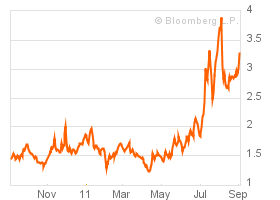
The European markets were buoyed Monday by the announcement of a merger between two major Greek banks, with a capital injection from Qatari interests. While such a development is a positive first step, why are Greek 2-year yields still north of 45%? At these levels, the market continues to discount a Greek default. It's a question of when, not if.

Greek 2-year bond yields still soaring


Bulls were also comforted by reports that the EU and ECB were working a radical rescue plan:
Following weeks of heavy losses for banking stocks across Europe, the Sunday Times in the UK reported Sunday that European officials are working on a "radical plan" to prevent a fresh pan-European credit crunch.

Without citing sources, the paper said officials from the European Central Bank and European Commission are considering offering central guarantees over certain types of debt issued by banks.
How plausible a solution?
This sounds like a version of the Swedish solution that I suggested before. While this is certainly possible I just don't see it as being plausible given the lack of agreement among the European. Consider this account from Richard Smith, who posted on Naked Capitalism, of the disagreements among the major European players looking like a circular firing squad:
This is all displacement: no one wants to recognize the losses and write off the debt, yet; not in Europe, (and not in the US, either, as we know well). There’s still too much room to argue about whether it’s liquidity or solvency, and about who should end up holding the bag, et cetera. Round and round it goes.
Nick Rowe at Worthwhile Canadian Initiative hit the nail on the head by outlining the political issue in Europe:
The Tea Party is much more powerful in Europe than in the US. Read Ambrose Evans-Pritchard to see an example. It's just they don't call it the "Tea Party" in Europe. It doesn't seem to have a name over there, but that's what it is.

The basic philosophy underlying the Tea Party is, at its crudest: "We're not paying for them". Who's "we" and who's "them" differs across two centuries and across the Atlantic Ocean, but it's still recognisably the same philosophy. The Tea Party makes life difficult for the Lender of Last Resort, because the Tea Party wants some sort of guarantee it will get its money back. And that guarantee can never be made cast-iron. If it could, you probably wouldn't need a Lender of Last Resort in the first place.
He concluded:

It's hard deciding these things when there is one central bank governor, one finance minister, and one country. With 17, it's a lot harder. As I have said before. Mish says it's "17 veto points".
In my last post entitled "Not too late to buy the long bond", I wrote, "In the absence of policy intervention, the path of least resistance for equities is down." I don't see any developments here that indicate anything that changes my views.

Monday, August 29, 2011

Not too late to buy the long bond

Have you seen the plastic smiles on some people? Their lips are smiling but the body language from the rest of the face say something else - the smile isn't genuine. That's what seems to be happening with the equity market right now. Here is the plastic smile in the form of the VIX and short-term sentiment indicators. The VIX Index spiked to over 40 - which is a sign of panic in the markets. In the past, such levels have marked intermediate term turning points for stocks. In addition, short-term investor sentiment is in bearish territory, which is contrarian bullish.


While sentiment indicators are bearish and therefore flashing a contrarian bullish signal, my cross-asset analysis is asking "Where's the fear in the rest of the market?"

When you read the headlines, the concerns that equities face today are a combination of a US recession and a European banking crisis. But if there were truly fears of a recession, then the prospect of slowing demand should cause commodity prices to go into freefall. Today, commodity prices are in a controlled downtrend but they aren't in freefall as they were in 2008.


If the markets were fearful about a European banking crisis, then the logical safe haven of choice of any size would be US Dollars. Today, the USD hasn't shown any great inclination to rally as they did in 2008.


No blood in the streets yet
To me, it doesn't sound like there is enough panic out there to warrant the assessment of a washed out market. To get another perspective, David Rosenberg wrote the following last Friday about equities:
If this is a plain vanilla correction, then a buying opportunity is likely at hand. But if we are about to enter a recession, then there will probably be another year of market weakness to endure. If there is a recession ahead, and it does look as though the odds of one are rising inexorably, then take note that only 27% of bear markets occur prior to the first month of economic contraction (in terms of the total decline from the pre-recession highs). So no matter how much the market anticipates, it is never enough at the onset - the bear phase is only a bit more than one-quarter done by the time the recession tide washes ashore.
What if wasn't just any ordinary recession but a (European) financial crisis that topples the global economy into a recession, just as we saw in 2008? If we were to look at 2008 episode as an analogy, then where are we?


In early 2008, stocks broke down out of a long multi-year uptrend on high volume (first circle). Stock prices then rallied and then weakened, with the $147 oil price marking the final top before the waterfall decline into the AIG-Wachovia-Lehman Crisis low.

Today, stocks have broken down from an uptrend dating back to the March 2009 bottom on high volume. If this were to be a repeat of 2008, could the market only be at the first break similar to the one seen in early 2008?

History doesn't repeat itself, it rhymes. The difference between 2011 and 2008 is that commodity prices have already topped out (see previous chart). The truth is probably somewhere in between. If this were 2008, my best guess is that we are probably somewhere between one-third or halfway through the decline.


A fragile Europe
It's a question of when, not if, Europe blows up. John Mauldin has written a very good summary of the problem in Europe here. The market is already showing signs of high systemic risk in the financial system consistent with a Russia Crisis or Subprime Crisis. (Incidentally, Mauldin is calling for a recession within the next twelve months and I concur with his assessment.)

The European banking system is very fragile and any minor breeze could make the whole structure topple. As Bruce Krasting pointed out, it took Drexel ten days to go under once the firm lost its funding sources. Already, the story that the ECB is tapping the Fed's USD swap lines is a serious sign of stress. How long would it take if a second or third tier European bank to go under if it got into trouble? (Less than ten days, I'll bet.) If a small bank became insolvent, then what would the contagion effects be?

What to do?
I've said this and I'll say it again. In the absence of policy intervention, the path of least resistance for equities is down. I have also shown that, based on valuation metrics, the downside potential during a panic could be as low as the 2009 bottom.

For investors and traders, the safe haven of choice remains USD denominated default-free Treasury assets. Market analysts got excited a couple of weeks ago when they pointed out that the 10-year yield was at the lows set during the Lehman Crisis panic.


Looking at the chart, I can see that the 10-year Treasury yield has more downside potential as it remains in a multi-decade downtrend. A target of 1.2% from the current 2.2% level is possible in the next few months.

The biggest bang for the bucks remains the long bond. While 10-year yields decline to the 2008 levels recently, the downside potential on long bond yields are much greater. The most recent FOMC announcement that rates would be kept low for another two years was a signal for the market to take on the carry trade - to borrow short and lend long for at least two years. This caused the yield curve to flatten in the short end but steepen in the long end. The downside potential on the 30-year is 2.0% from the current 3.5% level - a much greater capital gains potential of roughly 25% given its higher duration (and therefore higher interest rate price sensitivity of the long bond) compared to the 10-year.


My point and figure analysis of TLT, the long Treasury bond ETF, tells the same story. The point and figure chart below shows an initial target of roughly $130. If we were to calculate the ultimate target from the breakout by turning the size of the base vertically, the ultimate long-term target could be as high as $150. (For a more tactical view of TLT, see this commentary from Afraid to Trade.)

Putting it all together, the combination of my analysis of the 30-year yield and the TLT price chart both point to an initial estimate of 20-25% of potential price upside in the long Treasury bond. For non-US investors, the capital gains potential could be even greater as the USD tends to appreciate during periods of crisis.


Key risk: The scenario that I laid out depends on the absence of policy intervention, which I believe is unlikely. There is no appetite in the Congress for another round of fiscal stimulus and the Fed is out of bullets. Mohamed El-Erian of PIMCO pointed out that Bernanke said, in essence, that the Fed has done all it could and it's time for Congress to enact policies "that promote a stronger recovery in the near term [which] may serve longer-term objectives as well."

Meanwhile in Europe, EU governments are paralyzed by bickering and there is no consensus on what to do. The ECB appears to be too dogmatic to embark on quantitative easing. That's a recipe for disaster.