Wednesday, March 16, 2022

Great (bearish) expectations

Mid-week market update: The bears have exhibited great expectations for risk assets. Ed Clissold of Ned Davis Research observed that the NDR Crowd Sentiment has been at a sub-30 reading, which is historically bullish. However, he pointed out that momentum is negative and hedged with "sentiment is extremes differ cycle to cycle, so it's best to wait for sentiment to begin to reverse".


The full post can be found here.

Sunday, March 13, 2022

Beware the Ides of March

Preface: Explaining our market timing models 
We maintain several market timing models, each with differing time horizons. The "Ultimate Market Timing Model" is a long-term market timing model based on the research outlined in our post, Building the ultimate market timing model. This model tends to generate only a handful of signals each decade.

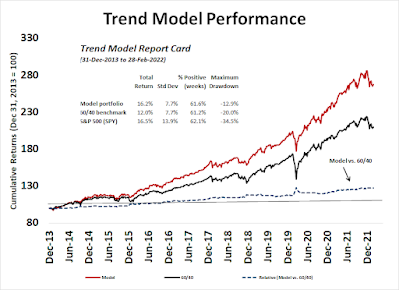
The Trend Asset Allocation Model is an asset allocation model that applies trend following principles based on the inputs of global stock and commodity price. This model has a shorter time horizon and tends to turn over about 4-6 times a year. The performance and full details of a model portfolio based on the out-of-sample signals of the Trend Model can bsoe found here.


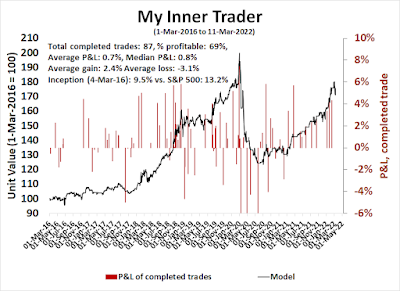
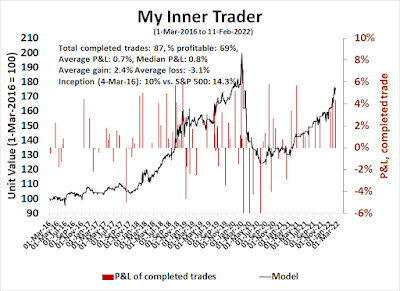
My inner trader uses a trading model, which is a blend of price momentum (is the Trend Model becoming more bullish, or bearish?) and overbought/oversold extremes (don't buy if the trend is overbought, and vice versa). Subscribers receive real-time alerts of model changes, and a hypothetical trading record of the email alerts is updated weekly here. The hypothetical trading record of the trading model of the real-time alerts that began in March 2016 is shown below.


The latest signals of each model are as follows:
  • Ultimate market timing model: Buy equities*
  • Trend Model signal: Neutral*
  • Trading model: Bullish*
* The performance chart and model readings have been delayed by a week out of respect to our paying subscribers.

Update schedule: I generally update model readings on my site on weekends and tweet mid-week observations at @humblestudent. Subscribers receive real-time alerts of trading model changes, and a hypothetical trading record of those email alerts is shown here.

Subscribers can access the latest signal in real-time here.


No lack of volatility
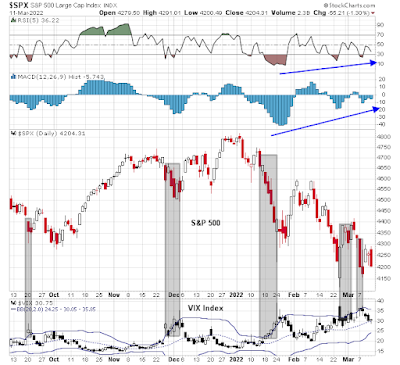
This stock market certainly does not lack volatility. The VIX Index underwent a recent series of upper Bollinger Band rides (shaded zones) while exhibiting positive RSI and MACD divergences. 


The next known source of volatility starts on March 15, the Ides of March, as the FOMC convenes for its regularly scheduled meeting. 

The full post can be found here.

Saturday, March 12, 2022

Not your father's commodity bull

Some chartists have recently become excited over the commodity outlook. Setting aside the headline-driven rise in oil prices, the long-term chart of industrial metals like copper looks bullish. Copper is tracing out a cup-and-handle pattern breakout that targets strong gains in the years ahead. Moreover, the one-and the two-year rate of change, which is designed to look through the effects of the COVID Crash, are elevated but not out of line with past bull phases.


The point and figure chart of copper appears equally impressive. The measured target on a point and figure breakout is an astounding 9.50, which is over a double from current prices.

Is this the start of a new commodity bull? I would argue that this is not your father's commodity bull market.

The full post can be found here.

Wednesday, March 9, 2022

A double bottom?

Mid-week market update: The S&P 500 put in a potential double bottom when it tested its recent lows while exhibiting a positive RSI divergence. Stock prices rallied on the news of a ceasefire in order to allow civilians to evacuate.


Is this a durable bottom?

The full post can be found here.

Sunday, March 6, 2022

Panicked enough a relief rally?

Preface: Explaining our market timing models 
We maintain several market timing models, each with differing time horizons. The "Ultimate Market Timing Model" is a long-term market timing model based on the research outlined in our post, Building the ultimate market timing model. This model tends to generate only a handful of signals each decade.

The Trend Asset Allocation Model is an asset allocation model that applies trend following principles based on the inputs of global stock and commodity price. This model has a shorter time horizon and tends to turn over about 4-6 times a year. The performance and full details of a model portfolio based on the out-of-sample signals of the Trend Model can bsoe found here.


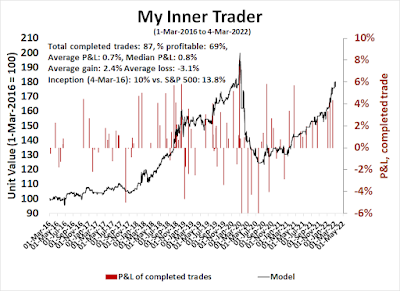
My inner trader uses a trading model, which is a blend of price momentum (is the Trend Model becoming more bullish, or bearish?) and overbought/oversold extremes (don't buy if the trend is overbought, and vice versa). Subscribers receive real-time alerts of model changes, and a hypothetical trading record of the email alerts is updated weekly here. The hypothetical trading record of the trading model of the real-time alerts that began in March 2016 is shown below.


The latest signals of each model are as follows:
  • Ultimate market timing model: Buy equities*
  • Trend Model signal: Neutral*
  • Trading model: Bullish*
* The performance chart and model readings have been delayed by a week out of respect to our paying subscribers.

Update schedule: I generally update model readings on my site on weekends and tweet mid-week observations at @humblestudent. Subscribers receive real-time alerts of trading model changes, and a hypothetical trading record of those email alerts is shown here.

Subscribers can access the latest signal in real-time here.


Scared enough?
Are you scared enough? The market is extremely jittery. News last week of a Russian attack that started a fire at a Ukrainian power plant sparked a risk-off episode. Further sober analysis revealed that the incident was under control and there was no radiation leak. Worries about the incident sparking a second Chernobyl disaster are overblown.

Two weeks ago, the AAII weekly sentiment survey showed the bull-bear spread had fallen to -30, but it rebounded last week to -11. Readings of -30 are rare and they have only been lower during the bear markets of 1990 and 2008 (shown in pink). These levels weren't even seen in the wake of the Crash of 1987. In all cases, they signaled short-term bottoms.
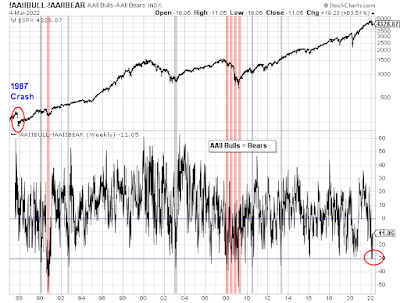


The key question for investors is whether current conditions represent a durable market bottom, or just a bear market rally.

The full post can be found here.

Saturday, March 5, 2022

An energy and geopolitical recession?

Much has happened in the space of a week. In the wake of Russia's Ukrainian invasion, the West has responded with a series of tough sanctions designed to tank the Russian economy. Energy and other commodity prices have soared and this is shaping up to be another energy and geopolitical crisis. The last three episodes resolved in recessions, which are equity bull market killers. Fourth time lucky?
  • The 1973 Arab Oil Embargo
  • The 1979 Iranian Revolution
  • The 1990 Gulf War
  • The 2022 Russia-Ukraine Energy Shock (?)
The backdrop sounds dire. Nouriel Roubini recently warned of stagflation in a Project Syndicate essay. An analysis from Oxford Economics shows that the shocks will hit the Russian economy, but Europe will not be spared. The US is expected to see the least negative impact from the Russia-Ukraine energy shock.


As the Fed embarks on its tightening cycle, it faces a nightmare stagflation scenario of higher energy and commodity prices pressuring inflation and falling economic growth. 

The full post can be found here.

Wednesday, March 2, 2022

A key test at neckline support

Mid-week market update: Will the S&P 500 hold support or will it break? The index is once again testing the neckline of a potential head and shoulders pattern while exhibiting a minor positive RSI divergence.


Here are the bull and bear cases.

The full post can be found here.

Sunday, February 27, 2022

I'll never complain about a lack of panic again

Preface: Explaining our market timing models 
We maintain several market timing models, each with differing time horizons. The "Ultimate Market Timing Model" is a long-term market timing model based on the research outlined in our post, Building the ultimate market timing model. This model tends to generate only a handful of signals each decade.

The Trend Asset Allocation Model is an asset allocation model that applies trend following principles based on the inputs of global stock and commodity price. This model has a shorter time horizon and tends to turn over about 4-6 times a year. The performance and full details of a model portfolio based on the out-of-sample signals of the Trend Model can bsoe found here.


My inner trader uses a trading model, which is a blend of price momentum (is the Trend Model becoming more bullish, or bearish?) and overbought/oversold extremes (don't buy if the trend is overbought, and vice versa). Subscribers receive real-time alerts of model changes, and a hypothetical trading record of the email alerts is updated weekly here. The hypothetical trading record of the trading model of the real-time alerts that began in March 2016 is shown below.


The latest signals of each model are as follows:
  • Ultimate market timing model: Buy equities*
  • Trend Model signal: Neutral*
  • Trading model: Neutral*
* The performance chart and model readings have been delayed by a week out of respect to our paying subscribers.

Update schedule: I generally update model readings on my site on weekends and tweet mid-week observations at @humblestudent. Subscribers receive real-time alerts of trading model changes, and a hypothetical trading record of those email alerts is shown here.

Subscribers can access the latest signal in real-time here.


A reversal bottom
Last week, I lamented that the stock market appeared to be fearful, but not panicked. Be careful what you wish for, you might just get it.

On Wednesday, the S&P 500 violated a key neckline support level of an apparent head and shoulder pattern. On Thursday, the Russian Army crossed into Ukrainian territory and conducted what Putin called a "special military operation". Global markets adopted a risk-off tone and S&P 500 futures were down -2.5% overnight. The index opened deeply in the red but recovered strongly on the day on high volume to form a classic reversal bottom.


If war is what it took, I'll never ask the market gods for panic again.

The full post can be found here.
Saturday, February 26, 2022

Wars are equity bullish, but there's a catch...

Four weeks ago, I suggested that investors buy to the sound of cannons. Now that the cannons have sounded, is that still a good idea?

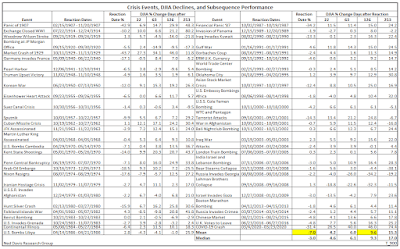
Yes, but there's a catch. A detailed list of past crises from Ed Clissold of Ned Davis Research reveals that stock prices usually rebound strongly after sudden shocks such as war. On average, the DJIA is up 4.2% after a month and 15.3% a year later.


Here's the catch...

The full post can be found here.

Wednesday, February 23, 2022

Knife catching at a time of war

Mid-week market update: Trying to spot a bottom here is like trying to catch a falling knife - and at a time of war. Here is what I am watching in order to navigate the turmoil.

It's official. We are entering the Biden administration's "trade talks are going very well with China" phase of market psychology where asset prices respond to every headline in the Russia-Ukraine conflict. Since it's virtually impossible to predict what's ahead on the geopolitical front, traders can only focus on technical internals and how stock prices respond to news.

Virtually every chartist can see the developing head and shoulders pattern in the S&P 500, but that's not the entire story and investors should look for signs of confirmation from other indicators.


The full post can be found here.

Sunday, February 20, 2022

Fearful, but not panicked

Preface: Explaining our market timing models 
We maintain several market timing models, each with differing time horizons. The "Ultimate Market Timing Model" is a long-term market timing model based on the research outlined in our post, Building the ultimate market timing model. This model tends to generate only a handful of signals each decade.

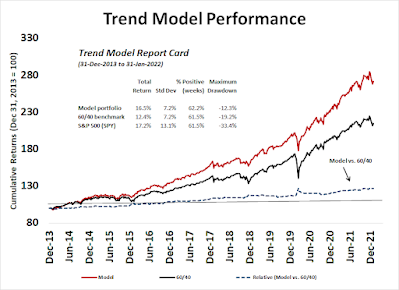
The Trend Asset Allocation Model is an asset allocation model that applies trend following principles based on the inputs of global stock and commodity price. This model has a shorter time horizon and tends to turn over about 4-6 times a year. The performance and full details of a model portfolio based on the out-of-sample signals of the Trend Model can bsoe found here.


My inner trader uses a trading model, which is a blend of price momentum (is the Trend Model becoming more bullish, or bearish?) and overbought/oversold extremes (don't buy if the trend is overbought, and vice versa). Subscribers receive real-time alerts of model changes, and a hypothetical trading record of the email alerts is updated weekly here. The hypothetical trading record of the trading model of the real-time alerts that began in March 2016 is shown below.


The latest signals of each model are as follows:
  • Ultimate market timing model: Buy equities*
  • Trend Model signal: Neutral*
  • Trading model: Neutral*
* The performance chart and model readings have been delayed by a week out of respect to our paying subscribers.

Update schedule: I generally update model readings on my site on weekends and tweet mid-week observations at @humblestudent. Subscribers receive real-time alerts of trading model changes, and a hypothetical trading record of those email alerts is shown here.

Subscribers can access the latest signal in real-time here.


The drumbeats of war
From a purely fundamental perspective, the US equity outlook is mildly bullish. However, rising geopolitical risk premium is unsettling risk appetite. Sentiment surveys such as AAII have fallen into the fear zone. In the past, such readings have resolved in relief rallies.


While fear levels are elevated, the market is neither panicked nor oversold, which is an indication that there may still be unfinished business to the downside once the market bounce is over.

The full post can be found here.
Saturday, February 19, 2022

Peak Fed tightening anxiety?

The past week saw rising anxiety about a flattening yield curve rise to a crescendo. The 2s10s spread narrowed to as low as 40 bps before recovering and ending the week at 46 bps. Coincidentally, the BoA Global Fund Manager Survey showed an overwhelming majority of respondents hold believe the yield curve will flatten.


Even though it hasn't inverted yet, an inverted yield curve has signaled recessions in the past. This raises two key questions for investors.
  1. What's the near-term outlook for inflation?
  2. Is the Fed willing to drive the economy into a recession in order to fight inflation?
The full post can be found here.

Tuesday, February 15, 2022

Don't forget about the intermediate-term trend

Mid-week market update: I wrote on Monday (see Everything but the kitchen sink) that market sentiment was overly stretched on the downside, "If you are short here, you need a catastrophe within the next 10 days, otherwise, you run the risk of a rip-your-face-off relief rally."

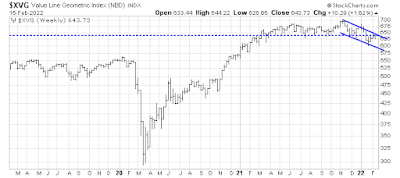
The relief rally appeared right on cue on Turnaround Tuesday and prices stabilized today in the wake of the release of the FOMC minutes. Before the bulls get too excited, don't forget that the intermediate trend is still down. The Value Line Geometric Index, which measures the performance of the average stock, broke a long-term support level and is tracing out a falling channel.


The full post can be found here.

Monday, February 14, 2022

Everything but the kitchen sink

I must admit, the bears are trying their best. They've thrown everything but the kitchen sink at the stock market: The prospect of a half-point rate hike, an inter-meeting hike, and the looming risk of an armed Russia-Ukraine conflict. 


Despite all the bad news, the S&P 500 is holding above its January lows. What's next, an asteroid from outer space?

The full post can be found here.
Sunday, February 13, 2022

Three questions to ask as fear spikes

Preface: Explaining our market timing models 
We maintain several market timing models, each with differing time horizons. The "Ultimate Market Timing Model" is a long-term market timing model based on the research outlined in our post, Building the ultimate market timing model. This model tends to generate only a handful of signals each decade.

The Trend Asset Allocation Model is an asset allocation model that applies trend following principles based on the inputs of global stock and commodity price. This model has a shorter time horizon and tends to turn over about 4-6 times a year. The performance and full details of a model portfolio based on the out-of-sample signals of the Trend Model can bsoe found here.


My inner trader uses a trading model, which is a blend of price momentum (is the Trend Model becoming more bullish, or bearish?) and overbought/oversold extremes (don't buy if the trend is overbought, and vice versa). Subscribers receive real-time alerts of model changes, and a hypothetical trading record of the email alerts is updated weekly here. The hypothetical trading record of the trading model of the real-time alerts that began in March 2016 is shown below.


The latest signals of each model are as follows:
  • Ultimate market timing model: Buy equities*
  • Trend Model signal: Neutral*
  • Trading model: Bullish*
* The performance chart and model readings have been delayed by a week out of respect to our paying subscribers.

Update schedule: I generally update model readings on my site on weekends and tweet mid-week observations at @humblestudent. Subscribers receive real-time alerts of trading model changes, and a hypothetical trading record of those email alerts is shown here.

Subscribers can access the latest signal in real-time here.


Another 200 dma test
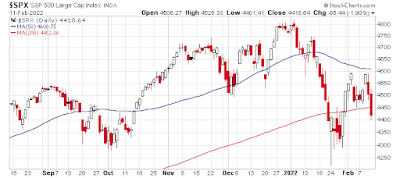
In the wake of the drama that played out in the stock market last week, the S&P 500 weakened to test the 200 dma. Is this just a re-test of the January lows or the start of a new bear leg?


To answer that question, I step outside the realm of pure technical analysis and pose three questions for both bulls and bears.
  1. What will happen to earnings and earnings expectations in the wake of the hot January CPI report that spooked the market?
  2. Fed Funds futures are now discounting a half-point liftoff at the March FOMC meeting. Some analysts have even speculated that the Fed may raise by a quarter-point in a surprise inter-meeting move. Will the Fed acquiesce or push back against those expectations?
  3. If stock prices were to weaken further, how will insiders react?
The full post can be found here.

Saturday, February 12, 2022

A 2022 inflation tantrum investing roadmap

In the wake of the hot January CPI print, I have had a number of discussions with readers about the most advantageous way of positioning an equity portfolio in a rising rate environment. The most obvious strategy is to use an allocation similar to the Rising Rates ETF (EQRR) is to tilt towards value and cyclical stocks.


Beneath the surface, however, such an approach carries considerable risks owing to growing negative divergences. Instead, I present a framework for managing the inflation tantrum of 2022.

The full post can be found here.

Wednesday, February 9, 2022

In the eyes of the beholder

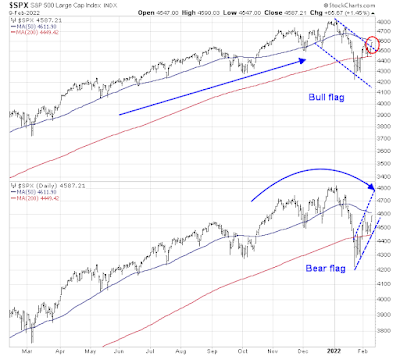
Mid-week market update: Technical analysis can be highly interpretative. Consider, for example, the bull or bear flag, which is a continuation pattern. For the uninitiated, a bull flag is a pullback within a bull trend and the trend is deemed to have continued when the stock or index stages an upside breakout from the flag. The reverse holds for a bear flag.

With that brief explanation in mind, did the S&P 500 just break out of a bull flag, or is it still tracing out bear flag?


Bullishness and bearishness are in the eyes of the beholder.

The full post can be found here.

Sunday, February 6, 2022

4 reasons to be bullish, 4 to be bearish

Preface: Explaining our market timing models 
We maintain several market timing models, each with differing time horizons. The "Ultimate Market Timing Model" is a long-term market timing model based on the research outlined in our post, Building the ultimate market timing model. This model tends to generate only a handful of signals each decade.

The Trend Asset Allocation Model is an asset allocation model that applies trend following principles based on the inputs of global stock and commodity price. This model has a shorter time horizon and tends to turn over about 4-6 times a year. The performance and full details of a model portfolio based on the out-of-sample signals of the Trend Model can bsoe found here.


My inner trader uses a trading model, which is a blend of price momentum (is the Trend Model becoming more bullish, or bearish?) and overbought/oversold extremes (don't buy if the trend is overbought, and vice versa). Subscribers receive real-time alerts of model changes, and a hypothetical trading record of the email alerts is updated weekly here. The hypothetical trading record of the trading model of the real-time alerts that began in March 2016 is shown below.


The latest signals of each model are as follows:
  • Ultimate market timing model: Buy equities*
  • Trend Model signal: Neutral*
  • Trading model: Bullish*
* The performance chart and model readings have been delayed by a week out of respect to our paying subscribers.

Update schedule: I generally update model readings on my site on weekends and tweet mid-week observations at @humblestudent. Subscribers receive real-time alerts of trading model changes, and a hypothetical trading record of those email alerts is shown here.

Subscribers can access the latest signal in real-time here.


A dead cat bounce?
Now that the stock market has staged a relief rally, can it be characterized as just a dead cat bounce, or is it a more durable move? Arguably, the downdraft that began in January violated an uptrend. It would be difficult to believe that a market can recover to its previous highs that quickly after such technical damage.


Here are four reasons to be bullish and four to be bearish.

The full post can be found here.

Saturday, February 5, 2022

Can the Fed engineer a soft landing?

Stock market pullbacks happen. The normal equity risk of pullbacks is the price investors pay for better long-term performance. But a recent analysis by Oxford Economics found that the average S&P 500 pullback during non-recessionary periods is -15.4% and -36% during recessions.


Here is why this matters for equity investors. The recent peak-to-trough drawdown for the S&P 500 was about -10%. If there is no recession, the downside risk is relatively limited. However, Fed Funds futures expect five quarter-point rate hikes in 2022, with some strategists calling for as many as seven. The current rate of expected tightening will push the 2s10s yield curve to invert in late 2022 or early 2023, which would be a recession signal. Markets look ahead 6-18 months. A 2023 recession translates into an equity bear market in 2022. Suddenly, the recent -10% S&P 500 decline could become a prelude to a vicious bear market.

Ominously, the path of the stock market is following the pattern of 1982. In 1982, the economy was in recession. CPI was 7% and the Fed had been hiking aggressively. It was a mid-term election year and the second year of the Presidential Cycle. The market experienced a down January and saw a bearish turn-of-year barometer (TOY) signal. 


The key difference between today and 1982 is the recession question. With all of the G7 central banks except for the BoJ turning hawkish, can the Fed rescue the stock market from the 1982 analogue by engineering a soft landing?

The full post can be found here.
Wednesday, February 2, 2022

Panic and bounce, what's next?

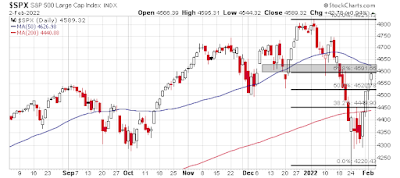
Mid-week market update: How far can the market rally run? The S&P 500 weakened in January and bottomed last week. It has mounted a strong relief rally, but it is testomg a key Fibonacci retracement level at about 4590 and a resistance zone at 4600-4630.


Is this the start of a V-shaped market recovery, or will the market weaken to retest the old lows?

The full post can be found here.