Showing posts with label China. Show all posts

Saturday, January 11, 2025

A preview of the Sino-American Trade War 2.0

China’s leadership was caught off-guard in 2016 because few people expected Trump to win the election. This time, Beijing has had plenty of warning, and it is far better prepared for Trade War 2.0.
 
The key difference is the divergence in the path of economic growth, as signaled by the bond market. Chinese 10-year yields have plunged below 2%, which is a sign of a dramatic slowdown. By contrast, U.S. 10-year Treasury yields have risen, which reflects concerns over a heightened fiscal deficit and rising inflation.


In the face of economic weakness, China seems to be preparing for Trade War 2.0 on a different dimension of belligerence. China has embraced von Clausewitz’s famous quote on war: “War is merely the continuation of politics by other means.”

Investors should prepare for greater newsflow volatility and rising geopolitical risk in the months ahead.

The full post can be found here.

Saturday, July 27, 2024

China slowdown = Reduce risk

It’s becoming harder and harder to avoid the cold hard facts. China is slowing. The PBOC unexpectedly cut interest rates last week. The central bank began by cutting the benchmark lending rate on overnight, 7-day and 1-month standing lending facility (SLF). The move was followed by another surprising 0.20% cut in its 1-year policy rate, which is more than its usual move of 0.10% cuts.

The Citi China Economic Surprise Index, which measures whether economic statistics are beating or missing expectations, peaked in Q1 and it has been falling ever since. The market had hoped for some signs of new direction or signals of stimulus from the Third Plenum, but the communiqué was uninspiring.
 
 
As China’s economy slows, there are signs that it’s starting to take a toll on global risk appetite.

The full post can be found here.

Saturday, March 2, 2024

Are you ready to be a contrarian cigar butt investor?

How would you feel about a star value manager with the track record shown in the chart below. While he beat the market in the wake of the dot-com bubble, he has only matched the performance of the S&P 500 since 2011. To be sure, he did beat his style benchmark (second panel).
 
The star manager is none other than the legendary Warren Buffett and the chart shows the relative performance of Berkshire Hathaway’s stock price relative to the S&P 500 and the Russell 1000 Value Index. Buffett’s best known recent win was his purchase of Apple in 2016 which became his largest holding, and whose relative returns are shown in the bottom panel.

 
I examine how he achieved his results, and offer studies of sources of alpha as examples of different investing styles.

The full post can be found here.

Saturday, February 10, 2024

How investable is China? (Revisited)

About a year ago, when China emerged out of its zero-COVID lockdowns, I rhetorically asked, “How investable is China?”. I concluded, “Long-term investors in China are likely to face subpar returns coupled with high volatility”.

Now that China’s troubles have returned, it’s time to revisit the China investability question. The accompanying chart shows that China’s debt has exploded over the past decades, driven by a regime of growth-at-any-cost malinvestment. Similar credit cycles in other economies have resolved in financial crises. Will China be any different and how should investors react?

 The full post can be found here.

Saturday, January 27, 2024

What are the contagion effects of China's wipeout?

The problems keep piling up in China. Weakening demographics, as her population shrank for a second consecutive year. Weak consumer spending. A record property downturn. Rising trade tensions.

The drip-drip-drip of these glitches culminated in a massive stock market wipeout as over US$6 trillion has been wiped from the combined capitalization of the Chinese and Hong Kong markets since the 2021 market peak. As an illustration of the depth of the carnage, the Hang Seng Index fell to test levels seen at the 1997 handover to China. Beijing responded with a plan to order State Owned Enterprises to use its offshore currency reserves, which is estimated to be 2-trillion yuan, or US$278 billion, to buy Chinese stocks to prop up the market. In addition, the PBoC announced a half-point cut to the required reserve ratio on February 5 to provide greater liquidity to the financial system.
 
 
For investors, the key question is what’s the effect of skidding stock prices in China and nearby Hong Kong on the rest of the world?

The full post can be found here.


Beat the price increase

We are announcing a 5% price increase on subscriptions, effective February 1, 2024. Existing subscribers will be grandfathered at their current rates.

If you haven't subscribed, click this link to beat the price increase.

Saturday, December 2, 2023

The market meaning of a gold breakout

Gold bulls became very excited when gold prices tested overhead resistance at the 2000–2100 level. In the past, such tests had been met with selling pressure, but technical analysts would interpret a definitive breakout at these levels as opening the door to significant upside.

Moreover, the bottom panel of the accompanying chart shows that the gold to S&P 500 ratio has been making a multi-year bottom, which argues for the start of a cycle that favours hard assets like gold and commodities over paper assets like stocks and bonds. Before you get too excited, such bottoms can take some time to develop and a hard asset bull market may not appear for several years.


In addition, the long-term bull case for commodities and hard assets is underscored by a regime of chronic underinvestment in capital expenditures in commodity extraction industries.


I am no gold bug and I have no strong opinion on the direction for gold prices. I am more interested in the cross-asset implications of this gold rally.
 
The full post can be found here.

Saturday, November 18, 2023

Assessing economic risk through the Biden-Xi meeting lens

The markets took a risk-on tone in the wake of a softer-than-expected CPI report, followed by a tame PPI report and strong retail sales print. Even before these reports, Mohamed El-Erian issued a warning about the goldilocks scenario of lower oil prices and falling bond yields.


Is market psychology in a “bad news is good news” mode that’s discounting weakness ahead? To answer that question, one useful way of seeing the world is through the lens of last week’s meeting between Joe Biden and Xi Jinping on the sidelines of the APEC Summit in San Francisco. The U.S. and China met to stabilize their relationship, but each is coming to the table with deep wounds, which are useful in evaluating potential weakness that could affect the global economy. The actual progress made at the meeting was modest, but it’s less important inasmuch as what it revealed about the vulnerabilities of each economy to the growth risks highlighted by El-Erian.

The full post can be found here.

Saturday, August 19, 2023

What are the contagion effects of a China slowdown?

Periodically, the market is rattled by a “China is slowing” narrative. As the accuracy of official Chinese statistics can be doubtful, the real-time market reaction indicates nervousness, but no panic. The performance of the equity markets of China and her major trading partners relative to MSCI All-Country World Index (ACWI) shows that their trends are all flat to down.


How concerned should investors be about a China slowdown and its contagion effects?

The full post can be found here.

Saturday, May 20, 2023

How the G7 meeting exposes the risks for 2024

Two weeks ago I highlighted how history shows that the stock market only bottomed after recessions have begun (see How to spot the stock market bottom) and a recession is likely on the way in H2 2023. If that is the case, U.S. equities should bottom at some point this year and a recovery should be in full swing by 2024. 


However, the agenda of G7 Summit in Hiroshima highlights the geopolitical risks to the 2024 recovery and the threat to global growth in 2024 and beyond.
 
 
The full post can be found here.

Saturday, February 4, 2023

A risk of transitory disinflation

The main event last week for US investors was the FOMC decision. As expected, the Fed raised rates by a quarter-point and underlined that "ongoing increases in the target range will be appropriate". Powell went on to clarify that "ongoing increases" translated to a "couple" of rate hikes, which would put the terminal rate at 5.00% to 5.25%, a level that was just above market expectations. He went on to signal that the Fed does not expect to cut rates this year. Moreover, he stressed, "We will stay the course until the job is done".

Those statements appeared hawkish, until he allowed, "We can now say for the first time that the disinflationary process has started". In addition, he characterized financial conditions as tight when it was obvious that markets had been taking on a risk-on tone since October. 

As a consequence, the Fed's hawkish warnings fell on deaf ears. Asset prices went into a risk-on mode in response to Powell's statements during the press conference. The market consensus terminal rate stayed at just below 5% and expectations of rate cuts at the end of 2023 changed from one to two. It took a strong surprise from the January Jobs Report to push the terminal rate above 5%, though easing expectations was pushed forward into mid-year.


To be sure, inflationary pressures are softening in a constructive way, but the risk of transitory disinflation is rising.

The full post can be found here.

Saturday, January 28, 2023

FOMC preview: Party now, pay later

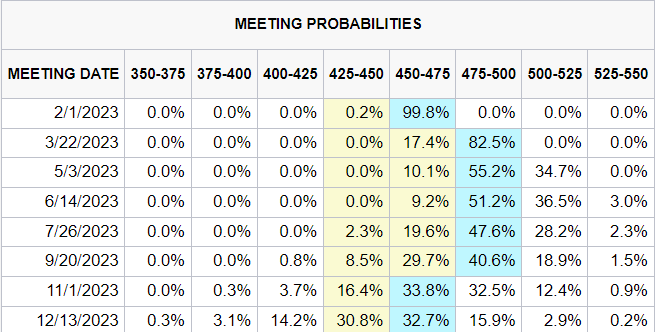
As investors look ahead to the FOMC decision on February 1, the market is expecting two consecutive quarter-point rate hikes, followed by a plateau, and a rate cut in late 2023.


The rate hike path and subsequent pause are consistent with the Fed's communication policy. Already, the Bank of Canada raised rates by a quarter-point last week and signaled a conditional pause in order to assess the lagged effects of past rate hikes. Expectations of falling rates later this year are contrary to the Fed's forward guidance. I am struck by a key sentence from the December FOMC minutes: "No participants anticipated that it would be appropriate to begin reducing the federal funds rate target in 2023,"

While there will be no dot plot published at the conclusion of the February FOMC meeting, the Fed's intentions can't be any clearer. There will be no cuts this year. In that case, what are the circumstances that could alter the Fed Funds trajectory?

The full post can be found here.

Saturday, January 21, 2023

Will the soft landing green shoots be trampled?

The stock market began 2023 with a rally based on the "green shoots" narrative of a Fed pivot and optimism about the effects of China reopening its economy. Since then, the S&P 500 rose to test resistance as defined by its falling trend line and pulled back. Similarly, the equal-weighted S&P 500, the mid-cap S&P 400, and the small-cap Russell 2000 all tested and failed at overhead resistance.


Are the "soft landing" green shoots being trampled? Here are the bull and bear cases.

The full post can be found here.

Saturday, January 14, 2023

Time to revisit the question: How investable is China?

There were some questions raised about the investability of China last year as regulatory uncertainty rose amidst some market turmoil. Fast forward to today, The MSCI Asia Pacific Index rose 20% from its October low and technically entered a new bull market. Enthusiasm is rising on the prospect of China's abandonment of its zero COVID policy and reopening its economy.

Emotions can run to extremes. Now that many investors are bulled up again, it's time to revisit the China investable question.


The full post can be found here.

Saturday, January 7, 2023

Three questions investors need to ask in 2023

IMF Managing Director Kristalina Georgieva recently said in a CBS Face the Nation interview that the IMF expects "one third of the world economy to be in recession". She went on to outline the differing outlooks for the three major trading blocs in the world, the US, EU, and China, plus emerging market economies.
For most of the world economy, this is going to be a tough year, tougher than the year we leave behind. Why? Because the three big economies, U.S., E.U., China, are all slowing down simultaneously. The US is most resilient. The U.S. may avoid recession. We see the labor market remaining quite strong. This is, however, mixed blessing because if the labor market is very strong, the Fed may have to keep interest rates tighter for- for longer to bring inflation down. The E.U. very severely hit by the war in Ukraine. Half of the European Union will be in recession next year. China is going to slow down this year further. Next year will be a tough year for China. And that translates into negative trends globally. When we look at the emerging markets in developing economies, there, the picture is even direr. Why? Because on top of everything else, they get hit by high interest rates and by the appreciation of the dollar. For those economies that have high level of that, this is a devastation.
That said, the stock market isn't the economy and looks forward past the IMF forecast, which is very similar to the consensus view of the global economy. From a relative performance viewpoint, US equities have skidded badly in the last two months, while European equities have soared. While the Chinese and Japanese Asian markets have staged relative rebounds in the same time frame, they remain range bound on a relative basis, and so does EM ex-China.


As investors bade goodbye to 2022 and look to 2023, here are some key questions to consider:
  • Can Europe, which the IMF considers to be in recession, maintain its leadership role?
  • How will China's economy behave in light of it reopening initiatives? Global investors can't get their Fed policy call right without getting the reopening trade call right/
  • Will the US enter into recession? The stock and bond markets are in disagreement. Stocks are expecting a soft landing, while bond yields have peaked and discounting substantial economic weakness.
The full post can be found here.

Saturday, December 3, 2022

How the World Cup almost unraveled China

The Chinese authorities were stuck between a rock and a hard place. On one hand, COVID caseloads were skyrocketing; on the other hand, after two years of a series of on-again-off-again of lockdowns, it was unsurprising that Chinese citizens, many of them young, got a case of cabin fever and protested the government's COVID policies in a series of nationwide demonstrations. A podcast from the Economist argued that the combination of strict lockdowns and ubiquitous government monitoring led to widespread dissatisfaction.

Two incidents were believed to be the final straws that were the catalysts for the unrest. The first was an apartment fire in the city of Urumqi in western Xinjiang, where 10 people died, in which fire exits were locked because of COVID restrictions that trapped occupants inside, and COVID barriers prevented firefighters from reaching the building. In addition, broadcasts of the World Cup showed numerous unmasked spectators in the stands, which ran counter to the government’s narrative that China was controlling the pandemic much better than the West.


Protests are relatively common in China, but it's rare to see them erupt spontaneously and in different cities. While the authorities appear to have the protests under control, it could be argued that broadcasts of the World Cup were a spark that almost unraveled China.

The full post can be found here.

Saturday, November 12, 2022

Who's swimming naked as the tide goes out?

Warren Buffett famously said that when the tide goes out, you find out who has been swimming naked. Now that the Fed is tightening financial conditions and the tide is going out, I undertake an analysis to find out what countries and sectors have been swimming naked, and who has been opportunisticaly swimming with the tide.


The full post can be found here.

Saturday, September 17, 2022

A pending major market bottom? It sounds too easy!

Is the universe unfolding as it should? Most technical and sentiment indicators argue for a near-term double bottom in the S&P 500. The June bottom was the initial capitulation bottom. The market rallied and it is poised to weaken and re-test the old lows in the near future. That's when the new bull begins.


The new bull narrative sounds far too easy. Macro and fundamental factors argue for further downside potential. The Powell Fed is in a "whatever it takes" mode to tame inflation. The 2-year Treasury yield has been climbing relentlessly, which is an indication of rising market expectations of a terminal Fed Funds rate. Forward P/E valuations are becoming increasingly challenging even as the E in the P/E ratio declines ahead of a likely recession. If support at the June low doesn't hold, SPY faces a possible air pocket and a rapid fall to the 260-320 support zone, which represents considerable downside risk from current levels.

The full post can be found here.

Saturday, July 30, 2022

Bearishness, begone!

The returns of my Trend Asset Allocation Model have been strong. Based on an "out of sample" record of signals from 2013 and a simulated portfolio that varies up to +/- 20% from a 60/40 benchmark, the model portfolio has managed to achieve equity-like returns with 60/40-like risk. Performance has also been consistently positive in the shorter time frames (to July 26, 2022).
  • 1 year: Model portfolio -8.1% vs. 60/40 -9.8%
  • 2 years: Model portfolio 7.1% vs. 60/40 4.2%
  • 3 years: Model portfolio 10.2% vs. 60/40 7.1%
  • 5 years: Model portfolio 10.9% vs. 60/40 7.8%
   

The Trend Model turned neutral from bullish in January 2022 and turned bearish in March. Amidst all the gloom about a global recession, it's time to become more constructive on equities. The signal has been upgraded to neutral from bearish.

Here's why.

The full post can be found here.

Saturday, July 16, 2022

How the Fed is acting like a bull in the china shop

The June CPI and PPI reports both came in higher than expectations. The good news is core CPI is decelerating. The bad news is both core sticky price CPI and Owners' Equivalent Rent, which is about one-third of core CPI, are rising rapidly. 


These readings confirm the market's expectations that the Fed will continue to tighten until something breaks. In effect, the Fed is behaving like the proverbial bull in a china shop.

The full post can be found here.

Sunday, July 10, 2022

China blinked, but can it save the world again?

Preface: Explaining our market timing models 
We maintain several market timing models, each with differing time horizons. The "Ultimate Market Timing Model" is a long-term market timing model based on the research outlined in our post, Building the ultimate market timing model. This model tends to generate only a handful of signals each decade.

The Trend Asset Allocation Model is an asset allocation model that applies trend following principles based on the inputs of global stock and commodity prices. This model has a shorter time horizon and tends to turn over about 4-6 times a year. The performance and full details of a model portfolio based on the out-of-sample signals of the Trend Model can be found here.


My inner trader uses a trading model, which is a blend of price momentum (is the Trend Model becoming more bullish, or bearish?) and overbought/oversold extremes (don't buy if the trend is overbought, and vice versa). Subscribers receive real-time alerts of model changes, and a hypothetical trading record of the email alerts is updated weekly here. The hypothetical trading record of the trading model of the real-time alerts that began in March 2016 is shown below.


The latest signals of each model are as follows:
  • Ultimate market timing model: Sell equities*
  • Trend Model signal: Bearish*
  • Trading model: Neutral*
* The performance chart and model readings have been delayed by a week out of respect to our paying subscribers.

Update schedule: I generally update model readings on my site on weekends and tweet mid-week observations at @humblestudent. Subscribers receive real-time alerts of trading model changes, and a hypothetical trading record of those email alerts is shown here.

Subscribers can access the latest signal in real-time here.


Beijing blinked
It's always the darkest before the dawn. Just as it seemed that the world was about to collapse into a synchronized global recession, Beijing announced that it's considering allowing the sale of 1.5T yuan (USD 220B) in local government bonds earlier than planned to fund infrastructure projects.


Commodities rallied on the news but China related equity markets greeted the announcement with a yawn. Can China rescue the global economy once again?

The full post can be found here.