Showing posts with label demographics. Show all posts

Monday, January 13, 2020

Demographics beyond the 2020s

I received some thoughtful feedback to my recent post (see The OK Boomer decade). In particular, one reader referred me to an article by Greg Ip of the WSJ regarding the demographic headwinds affecting the American labor force.
The U.S. will run out of people to join the workforce. Indeed, this bright cyclical picture for the labor market is on a collision course with a dimming demographic outlook. While jobs are growing faster than expected, population is growing more slowly. In July of last year, the U.S. population stood at 327 million, 2.1 million fewer than the Census Bureau predicted in 2014 and 7.8 million fewer than it predicted in 2008. (Figures for 2019 will be released at the end of the month.)


Population growth is dependent on two factors, fertility rate and immigration, but the US is fading in both areas:
The U.S. has had two longstanding demographic advantages over other countries: higher fertility and immigration. Both are eroding. Since 2008, the U.S. fertility rate has gone from well above to roughly in line with the average for the Organization for Economic Cooperation and Development, a group 36 mostly developed economies...

Meanwhile, the inflow of foreign migrants to the U.S. has been trending flat to lower, while trending flat to higher in other countries. Last year, the foreign-born population expanded by a historically low 200,000, according to the Census Bureau. The exact reasons are unclear. The illegal immigrant population had stopped growing before President Trump took office. Legal immigration remained above 1 million through 2018.
Indeed, the FRED Blog recently highlighted the difference between prime age population growth in the US and Canada and hinted that the widening spread may be explained by differences in immigration policy:
While fertility rates have declined a little, immigration has helped sustain population growth. Immigrants are typically of working age, so immigration can increase the working-age population specifically.

The 63 Canadian passengers (out of a total of 167) who died on the doomed Ukrainian airliner in Tehran provides a window on Ottawa's skilled immigration policy (via Bloomberg):
They were doctors, engineers and Ph.D. students. The Canadians who lost their lives in the plane crash in Iran were mainly highly educated professionals and students, a reflection of the country’s push to attract skilled workers in the face of an aging population.

As governments around the world grapple with how to make immigration work without fanning political flames, Canada has taken a different tack, welcoming newcomers last year at the fastest pace in decades. About 12% of Canada’s post-secondary school population is made up international students, according to the country’s data agency...

“It’s really difficult to train someone on that level, integrate them and absorb them as high talent,” Parisa Mahboubi, a senior policy analyst at C.D. Howe Institute, a Toronto-based research firm, said by phone. “Doctors and dentists for example, to be able to obtain the degree that they are able to work in Canada. It takes time. It is really sad for both countries, losing those brains,” she said.

Mahboubi is Iranian-Canadian and has lived in Canada for more than 13 years.

Last year, Canada added a net 437,000 people from abroad, despite being only a tenth the size of the U.S., helping to drive its fastest population increase in decades, even with declines in fertility.

“Immigration has been a driver of Canada’s economic and cultural development. And with natural population’s slow growth, immigration contribution to growth in the labor force and even the tax base has been becoming more important,” Mahboubi said.
If labor force growth is being hampered by population growth, what does that mean for the rest of the world, and the world's long-term economic growth potential?

The full post can be found here.

Sunday, December 29, 2019

The OK Boomer decade

Preface: Explaining our market timing models
We maintain several market timing models, each with differing time horizons. The "Ultimate Market Timing Model" is a long-term market timing model based on the research outlined in our post, Building the ultimate market timing model. This model tends to generate only a handful of signals each decade.

The Trend Asset Allocation Model is an asset allocation model which applies trend following principles based on the inputs of global stock and commodity price. This model has a shorter time horizon and tends to turn over about 4-6 times a year. In essence, it seeks to answer the question, "Is the trend in the global economy expansion (bullish) or contraction (bearish)?"

My inner trader uses a trading model, which is a blend of price momentum (is the Trend Model becoming more bullish, or bearish?) and overbought/oversold extremes (don't buy if the trend is overbought, and vice versa). Subscribers receive real-time alerts of model changes, and a hypothetical trading record of the those email alerts are updated weekly here. The hypothetical trading record of the trading model of the real-time alerts that began in March 2016 is shown below.


The latest signals of each model are as follows:
  • Ultimate market timing model: Buy equities*
  • Trend Model signal: Bullish*
  • Trading model: Bullish*
* The performance chart and model readings have been delayed by a week out of respect to our paying subscribers.

Update schedule: I generally update model readings on my site on weekends and tweet mid-week observations at @humblestudent. Subscribers receive real-time alerts of trading model changes, and a hypothetical trading record of the those email alerts is shown here.


Is demographics really destiny?
'Tis the season for strategists to publish their year-end forecasts for 2020. Instead of participating in that ritual, this is the second of a series of think pieces of what might lie ahead for the new decade (for the first see China, paper tiger).

It is said that demographics is destiny. Tom Lee at Fundstrat recently highlighted changes in spending and debt patterns. As the Baby Boomers age and fade into their golden years, the Millennial generation is entering its prime and they are poised to seize the baton of consumer spending, and eventually, political leadership.


Demographics is destiny holds true only inasmuch as people's desires at different ages are roughly the same. But their desires are constrained by financial circumstances. The combination of a generational shift and differences in financial circumstances has profound implications for the political landscape, policy, and investing.

I believe that the coming decade is likely be the "OK Boomer" decade that sees a passing of the baton to the Millennial cohort characterized by:
  • A greater focus on the effects of inequality
  • A political shift to the left
  • There are two policy effects that can be easily identified:
    1. The rise of MMT as a policy tool
    2. The rise of ESG investing
The question of whether these developments are good or bad is beyond my pay grade. However, investors should be prepared for these changes in the years to come.

The full post can be found here.


Sunday, March 24, 2019

How the market could melt-up

Preface: Explaining our market timing models
We maintain several market timing models, each with differing time horizons. The "Ultimate Market Timing Model" is a long-term market timing model based on the research outlined in our post, Building the ultimate market timing model. This model tends to generate only a handful of signals each decade.

The Trend Model is an asset allocation model which applies trend following principles based on the inputs of global stock and commodity price. This model has a shorter time horizon and tends to turn over about 4-6 times a year. In essence, it seeks to answer the question, "Is the trend in the global economy expansion (bullish) or contraction (bearish)?"

My inner trader uses a trading model, which is a blend of price momentum (is the Trend Model becoming more bullish, or bearish?) and overbought/oversold extremes (don't buy if the trend is overbought, and vice versa). Subscribers receive real-time alerts of model changes, and a hypothetical trading record of the those email alerts are updated weekly here. The hypothetical trading record of the trading model of the real-time alerts that began in March 2016 is shown below.


The latest signals of each model are as follows:
  • Ultimate market timing model: Sell equities*
  • Trend Model signal: Neutral*
  • Trading model: Bearish*
* The performance chart and model readings have been delayed by a week out of respect to our paying subscribers.

Update schedule: I generally update model readings on my site on weekends and tweet mid-week observations at @humblestudent. Subscribers receive real-time alerts of trading model changes, and a hypothetical trading record of the those email alerts is shown here.


Melt-up ahead?
While this is not my base case scenario, there is a decent chance that the stock market may melt-up in light of the Fed's extraordinarily dovish statement last week. One parallel to the market hiccup of late 2018 would be 1998, when the Fed stepped in to rescue the financial system in the wake of the Russia Crisis.


A melt-up in the current environment would be supported by the combination of loose monetary policy and easy fiscal policy.

The full post can be found here.

Monday, February 4, 2019

Demographics isn't destiny = History only rhymes

As new data has crosses my desk, I thought I would write a follow-up to my bullish demographic analysis published two weeks ago (see A different kind of America First). To recap, I observed that America is about to enter another echo demographic boom as the Millennial generation enters its prime earnings years.


A study by San Francisco Fed researchers pointed out that this should raise demand for equities from Millennials. This is especially important as the Baby Boomers reduce their equity holdings as they retire.


I then postulated that rising savings from Millennial should usher in another golden age in US equities.

This is the part where history doesn't repeat itself, but rhymes.

The full post can be found here.


A Special Announcement
We told you so. We told you the market was going down.

Here is the track of Humble Student of the Markets, where we are neither perma-bulls nor perma-bears. Most recently, we have been correctly bullish since the correction of 2015, and turned cautious in August 2018 (see Market top ahead? My inner investor turns cautious, August 5, 2018).


We were also timely at the 2009 bottom. We issued a call to buy beaten up low-priced stocks with high insider buying a week before the ultimate bottom (see Phoenix rising? February 24, 2009).


The out-of-sample record of our model trading portfolio in 2018 was up 42.9%. For more details, see our weekly updates here.

The recent market volatility has brought a flood of new subscribers, and we are announcing a price increase, and a number of other changes in order to better control the growth of our community. However, all subscribers will be grandfathered at their old prices.

The following changes will occur as of March 1, 2019:
  • The annual subscription price will rise from US$249.99 to US$365 per year.
  • The monthly subscription price will rise from US$24.99 to US$36.50 per month.
  • The 24-hour subscription will no longer be offered.
  • The embargo period for free content will change from two weeks to four weeks.
Remember, if you subscribe now, you will be grandfathered at the old price - permanently.

Sunday, January 20, 2019

A different kind of America First

Preface: Explaining our market timing models
We maintain several market timing models, each with differing time horizons. The "Ultimate Market Timing Model" is a long-term market timing model based on the research outlined in our post, Building the ultimate market timing model. This model tends to generate only a handful of signals each decade.

The Trend Model is an asset allocation model which applies trend following principles based on the inputs of global stock and commodity price. This model has a shorter time horizon and tends to turn over about 4-6 times a year. In essence, it seeks to answer the question, "Is the trend in the global economy expansion (bullish) or contraction (bearish)?"

My inner trader uses a trading model, which is a blend of price momentum (is the Trend Model becoming more bullish, or bearish?) and overbought/oversold extremes (don't buy if the trend is overbought, and vice versa). Subscribers receive real-time alerts of model changes, and a hypothetical trading record of the those email alerts are updated weekly here. The hypothetical trading record of the trading model of the real-time alerts that began in March 2016 is shown below.


The latest signals of each model are as follows:
  • Ultimate market timing model: Sell equities*
  • Trend Model signal: Neutral*
  • Trading model: Bullish*
* The performance chart and model readings have been delayed by a week out of respect to our paying subscribers.

Update schedule: I generally update model readings on my site on weekends and tweet mid-week observations at @humblestudent. Subscribers receive real-time alerts of trading model changes, and a hypothetical trading record of the those email alerts is shown here.


A bright tomorrow
Mark Hulbert recently wrote a column which determined that the US equity market is overvalued based on five of six valuation metrics. He concluded "if you were concerned last fall about stock market overvaluation, you should be almost as concerned now".


I beg to differ. I will show most of these valuation metrics are either not useful, distorted, or a product of the low interest environment that the market is operating under. I go on to sketch out a likely bright long and medium future for US equities, which argues for an America First approach to equity investing.

The full post can be found at our new site here.


A Special Announcement
We told you so. We told you the market was going down.

Here is the track of Humble Student of the Markets, where we are neither perma-bulls nor perma-bears. Most recently, we have been correctly bullish since the correction of 2015, and turned cautious in August 2018 (see Market top ahead? My inner investor turns cautious, August 5, 2018).


We were also timely at the 2009 bottom. We issued a call to buy beaten up low-priced stocks with high insider buying a week before the ultimate bottom (see Phoenix rising? February 24, 2009).


The out-of-sample record of our model trading portfolio in 2018 was up 42.9%. For more details, see our weekly updates here.

The recent market volatility has brought a flood of new subscribers, and we are announcing a price increase, and a number of other changes in order to better control the growth of our community. However, all subscribers will be grandfathered at their old prices.

The following changes will occur as of March 1, 2019:
  • The annual subscription price will rise from US$249.99 to US$356 per year.
  • The monthly subscription price will rise from US$24.99 to US$35.60 per month.
  • The 24-hour subscription will no longer be offered.
  • The embargo period for free content will change from two weeks to four weeks.
Remember, if you subscribe now, you will be grandfathered at the old price - permanently.

Monday, July 18, 2016

Demographics Apocalypse Now?

When I was a boy, I can remember the Zero Population Growth (ZPG) movement, which was a response to the Club of Rome's Limits to Growth Mathusian thesis of "the world has limited resources, but human population is rising exponentially and therefore ecological disaster looms". Somewhere along the way, birth rates fell in response to global industrialization, rising incomes and changing incentive structures. In an agrarian society, children are potential units of production. They can be put to work in the fields and support you in your old age. In an industrialized society, children are cost centers. It was no wonder that birth rates fell as the emerging market economies boomed.

Today, ZPG has been realized (and more). Human global population will stabilize and shrink some time in the 21st Century. In fact, global population is about to reach an inflection point in the not too distant future as the number of old people will soon exceed the number of young children (via Business Insider):


A demographic shift like this raises all sorts of questions. For investors, it brings into the question of future returns as Baby Boomer demand for retirement income starts to dominate capital market returns and strain government retirement benefits. For policy makers worldwide, the issues are how to fund retirement benefits, as well as how to structure policies to transition to an aging society.

The full post can be found at our new site here.


Website notice
If you found the above post to be of interest, come over to the new site and check out our track record. We have something for traders and investors alike:

Friday, November 6, 2015

How Muslims will (not) marry our daughters and conquer us with births

I love reading Zero Hedge. Its constant theme of disaster-is-just-around-the-corner is the financial equivalent of skimming the supermarket tabloid at the checkout to see which celebrity was caught with the babysitter. The most amusing headline I saw recently was about the rise of xenophobia in Germany entitled Muslim Man Warns Germans: "We Will Marry Your Daughters And Conquer You With Births":
A week ago, we showed a video of what we hoped was not representative of the general sentiment among Germans towards the refugee crisis as two ladies suggested, "Every year 2-3 million arrive...it’s generally about foreign infiltration." Now we have the other side as the following video shows a muslim man threatening a German that "his daughter will wear a headscarf and marry a Muslim and that Germans stand no chance with their low birth rate," adding that muslims will "conquer Europe not with weapons, but with birth rates."
OH PUH-LEEZ! I hope that readers took that as seriously as the tabloid story about the transsexual who obtained a sex change operation but ultimately became a lesbian.


A demographics lesson
In order to make good on that threat, Muslim newcomers would have to surpass European populations with higher birth rates and overwhelm the hosts culturally. I would suggest that the opposite is much more likely to occur.

Consider, for example, the 2008 UN report indicating that fertility rates have been plummeting in the Middle East.


While the UN report only documented the decline in birthrates, the reason is obvious from an economic perspective. Prosperity and development are the best forms of birth control. In an agrarian or hunter-gatherer society, children quickly become production units and therefore profit centers. In a modern industrialized society, children are cost centers.

Callum Thomas recently highlighted this well-known inverse relationship between income and fertility rates, though the topic of discussion at the time surrounded China`s decision to abolish its one-child policy.


Even though China has abolished its one-child policy and tacitly encouraging two children per family, getting people to have more babies is not as easy as it sounds, according to this NY Times article:
Demographers and economists say the cost and difficulty of child-rearing are likely to deter many eligible couples from having two children despite the relaxed rules, Mu Guangzong, a professor of demography at Peking University, said in a telephone interview.

“I don’t think a lot of parents would act on it, because the economic pressure of raising children is very high in China,” he said. “The birthrate in China is low and its population is aging quickly, so from the policy point of view, it’s a good thing, as it will help combat a shortage of labor force in the future. But many parents simply don’t have the economic conditions to raise more children.”
As I noted before, children become cost centers in industrialized societies and the economic incentives to procreate in the era of birth control are low.

Bottom line: Muslim Europeans are likely to see their birthrates decline and converge to the levels of their hosts.


Cultural assimilation or invasion?
The second question involves the issue of cultural assimilation, or cultural invasion. To answer that question, we can turn to two case studies: China and Iran.

During the 13th Century, the Mongols conquered China and established the Yuan Dynasty to rule China. Over the space of a generation, the Mongol conquerors adopted many of the habits of the locals and became, in many ways, Chinese:
Notwithstanding the aspects of their rule that were certainly negative for China, the Mongols did initiate many policies — especially under the rule of Khubilai Khan — that supported and helped the Chinese economy, as well as social and political life in China.

In order to ingratiate himself with Confucian China, for example, Khubilai restored the rituals at court — the music and dance rituals that were such an integral part of the Confucian ideology. He also founded ancestral temples for his predecessors — his father and Chinggis (Genghis) Khan (his grandfather) — in order to carry out the practices of ancestor worship that were so critical for the Chinese.

And in an even greater effort to ingratiate himself personally to the Chinese, Khubilai insisted on giving his second son, Jin Chin, a Chinese-style education. Confucian scholars tutored the young boy, and he was introduced to the tenets of both Confucianism and Buddhism.

Khubilai also set up institutions to rule China that were very familiar to the Chinese, adapting or borrowing wholesale many of the traditional governmental institutions of China. For example, the Six Ministries that had been responsible for carrying out policy were retained by Khubilai's government, as was the Secretariat, a decision-making body. And the provincial administrative structure that organized China into provinces, further divided into districts and counties and so on, was not changed. The Chinese, therefore, found much of the Yuan Dynasty's political structures to be familiar.
Cultural invasion is not as easy as it sounds - and that occurred in an instance when the invaders militarily conquered the region, which is not the case in Europe today.

For a more modern example, consider the demographics of Iran. As the chart below shows, about one-third of the population was alive when radical students stormed and took over the American embassy in 1980.


It also shows the long-term problem facing Iran`s religious clerics. Young Iranians are becoming secular, which creates problems of control by the ayatollahs, according to this NY Times Op-Ed that compared and contrasted the political landscape between Israel and Iran:
For more than three decades, Iran’s oil wealth has allowed its religious leaders to stay in power. But sanctions have taken a serious economic toll, with devastating effects on the Iranian people. The public, tired of Mr. Ahmadinejad’s bombastic and costly rhetoric, has replaced him with Hassan Rouhani, a pragmatist who has promised to fix the economy and restore relations with the West.

But Mr. Rouhani’s rise is in reality the consequence of a critical cultural and demographic shift in Iran — away from theocracy and confrontation, and toward moderation and pragmatism. Recent tensions between America and Russia have emboldened some of Iran’s radicals, but the government on the whole seems still intent on continuing the nuclear negotiations with the West.

Iran is a land of many paradoxes. The ruling elite is disproportionately made up of aged clerics — all men — while 64 percent of the country’s science and engineering degrees are held by women. In spite of the government’s concentrated efforts to create what some have called gender apartheid in Iran, more and more women are asserting themselves in fields from cinema to publishing to entrepreneurship.

Many prominent intellectuals and artists who three decades ago advocated some form of religious government in Iran are today arguing for popular sovereignty and openly challenging the antiquated arguments of regime stalwarts who claim that concepts of human rights and religious tolerance are Western concoctions and inimical to Islam. More than 60 percent of Iranians are under age 30, and they overwhelmingly believe in individual liberty. It’s no wonder that last month Ayatollah Khamenei told the clerical leadership that what worried him most was a non-Islamic “cultural invasion” of the country.
In other words, Iranian youth prefer to party rather than spend their days in religious devotion. If they are tilting towards western influences and culture, then the more likely outcome of a mass migration of Muslims into Europe is cultural assimilation.

For an example of how cultural assimilation can work, consider the new government of Canadian Prime Minister Justin Trudeau. While this is not a Trudeau endorsement, I would point out that new cabinet ministers include a former refugee from Afghanistan and a turban wearing Sihk who was a soldier with tours in Bosnia and Afghanistan as Minister of Defense.


Now, that`s assimilation!

Bottom line: Europe may experience some temporary indigestion as it copes with the flood of refugees, but the more likely long-term outcome will be "how Muslims will become more secular, affluent and see their birthrates fall."

Tuesday, October 6, 2015

Margin pressures = Subdued L-T equity returns

In a recent post (see Why this is not the start of a bear market), I raised the question of how a maturing economic cycle might pressure margins. My thesis was mainly based on analysis from Jim Paulsen of Wells Capital Management who believed that operating margins face a lose-lose situation in 2016 (emphasis added):
Earnings performance is well past its best for this recovery and investors need to consider whether earnings growth will prove sufficient to support current stock market valuations. The rapidly aging earnings cycle is perhaps best illustrated by an economy nearing full employment with corporate profit margins near record highs. Should global growth remain tepid and overall sales results modest, since profit margins are unlikely to rise much, earnings trends will also likely prove disappointing. Conversely, should global growth and corporate sales results accelerate, because the U.S. is nearing full employment, companies may soon face cost-push pressures and margin erosion which will likely off set improved sales results.

Essentially, it is difficult to see how earnings growth will be adequate during the rest of this mature recovery to support current price/earnings multiples. Is a relatively modest earnings growth against a backdrop of rising inflation and higher interest rates sufficient to support
The Atlanta Fed`s Labor Market Spider Chart shows the continued robustness of the US labor market as metrics have improved in the last six and twelve months, despite the disappointing Employment Report last Friday.


Indeed, the Atlanta Fed Wage Growth Tracker shows that wage pressures have been rising at a healthy clip, with prime age wage growth, which adjusts for the the demographic effects of aging Baby Boomers, up at 3.4% in August.


With the labor market still tight, you have to wonder to what extent rising wages are going to squeeze operating margins.


More long-term headwinds
So far, the case for margin compression has been an investment story for 2016. A Bloomberg article recently came across my desk indicating longer term global pressures on corporate margins.

That's because the demographic tailwind from a rising global labor supply is turning into a headwind:
Goodhart argues that since roughly 1970, the world has been in a demographic sweet spot characterized by a falling dependency ratio, or in plainer terms, a high share of working age people relative to the total population. At the same time, globalization provided multinational companies the ability to tap into this new pool of labor. This positive supply shock was a negative for established workers, forcing down the price of labor as capital flowed to these areas.

"Naturally, and quite properly, the West supplied much of the management; the East supplied the labor," wrote Goodhart.

Outsourcing labor to less costly locales kept wages at home from rising too fast. This, in turn, entailed that inflationary pressures were benign, as best depicted by the concept of the Great Moderation, or the idea that central bankers were better able to stabilize the business cycle.

As companies were encouraged to boost capacity with workers rather than capital equipment, this put downward pressure on the cost of the latter.

"Access to a new reserve army of cheap global labor through globalization has encouraged companies to invest in this workforce rather than in capital at home. A garment company, for example, could choose to build a highly automated, capital-intensive factory in the U.S. or build a low-tech, high-labor factory in the Far East," said Toby Nangle, who published a column on the connection between labor power and interest rates in May. "For years, companies have been choosing the latter option, which reduces the requirement for capital in the West, thereby reducing the price of that capital."


The positive operating margin effects of globalization are coming to an end as global population is aging.


Such a demographic development translates into wage and inflationary pressures (emphasis added):
Unlike many other economists, Goodhart does not believe the demographic backdrop of an aging population is inherently deflationary. The pool of labor around the globe that kept wages suppressed domestically on the island nation has nearly run dry; Japan, in other words, was a victim of circumstance. More generally, in order to meet the obligations of the state, the shrinking pool of workers will be forced to pay higher taxes at the same time that they'll be in a position to haggle for better wages.

"This is a recipe for a recrudescence of inflationary pressures," wrote Goodhart. "The present concerns about deflation are fleeting and temporary; enjoy it while it lasts."
Please note that the points raised in the article refer to long term forces affecting corporate profitability that stretch out decades into the future.


The McKinsey view
A Harvard Business Review article, which was adapted from work from the McKinsey Global Institute, told a similar story of a negative reversal in the effects on corporate operating margins from globalization:
[T]he favorable cost drivers that Western multinationals were able to exploit have largely run their course. Interest rates are now so low in many countries that borrowing costs simply can't fall much further and might even be starting to rise. The big tax-rate decline of the past three decades also seems to have ended. Indeed, tax inversion schemes, offshoring, and the use of transfer pricing are drawing political flak in several deficit-ridden countries.

As for labor costs, wages in China and other emerging markets are rising.

Rather than continuing to reap gains from labor arbitrage, companies will fight to hire skilled people for management and technical positions. New jobs require disproportionately greater skills, especially in science, engineering, and math. In China, once the main source of new workers, the demographic pressures of an aging population and falling birth rates could further increase the country's labor costs. And most other emerging markets do not yet have the high-quality rural education systems required to build a disciplined workforce.
If the world is becoming global, then global wage pressures are likely to rise:
The result is an intensifying global war for talent. In a recent McKinsey survey of 1,500 global executives, fewer than one-third said that their companies' leaders have significant experience working abroad-but two-thirds said that kind of experience will be vital for top managers in five years.
Companies are seeing other challenges. The business models of many companies have changed. New entrants are not necessarily focused on profitability, but market share:
The growth of these players has been supported by their ownership models.

Major U.S. and European companies' broad public ownership, board structure, and stock exchange listings typically enforce a sharp focus on near-term profitability and cost control. But many emerging-market firms are state- or family-owned and so have different operating philosophies and tactics. Many of the new competitors take a longer-term view, focusing on top-line growth and investment rather than quarterly earnings. Growth can be more important than maximizing returns on invested capital: Chinese firms, for example, have grown at a blistering pace-four to five times as fast as Western firms over the past decade, particularly in capital-intensive industries such as steel and chemicals.
It`s not just the emerging market players, many of which are state-owned, that go into a market and drive down prices by focusing on market share, but western companies in the technology space, such as Amazon.com and numerous tech start-ups intent on grabbing as much virtual real estate as they can:
Tech firms share some intriguing similarities with the new emerging-market giants. Both can be brutal competitors, and both often have tightly controlled ownership structures that give them the flexibility to play the long game. Many tech firms are privately held by founders or venture capital investors who prioritize market share and scale rather than profit. Amazon, Twitter, Spotify, Pinterest, and Yelp are on the growing list of companies that focus on increasing revenue or their user networks even while losing money over extended periods. That mindset-and the control of founders-sometimes persists even after the companies go public. Among NASDAQ-listed software and internet companies, founder-controlled firms have 60% faster revenue growth and 35% to 40% lower profit margins and returns on invested capital than do publicly held firms.
The study concluded that, much like the internet boom of the late 1990s, the benefits may accrue to the end user rather than the corporate provider of the new services:
But whereas the outlook for revenue growth is good, the profits picture looks less promising. Consumers could be the big winners, as could some workers-especially those in emerging markets and those with digital and engineering skills, which are in short supply. As we've seen, many companies' profit margins are being squeezed. Hospitality, transport, and health care have all experienced price declines in recent years because of the emergence of new platforms and tech-driven competitors. Similar effects could soon play out on a larger scale and expand to sectors such as insurance and utilities. Nobody is immune, but companies particularly at risk include those that rely on large physical investments to provide services or that act as intermediaries in a services value chain. Large emerging-market firms in less traded capital-intensive industries such as extraction, telecom, and transportation have been relatively protected so far, but that is changing, in part because of greater deregulation. Profits are not only shrinking but also becoming more uncertain. Since 2000 the return on invested capital has been about 60% more volatile than it was from 1965 to 1980.
These factors all combine to squeeze operating margins.


For investors looking out for 10 years or more, such a scenario translates into rising inflationary pressures (bonds will be poor performers) and lower corporate margins (diminished equity returns).


Don't abandon stocks!
While the apparent long-term outlook appears dire for both equity and fixed income, all is not lost. What demographics takes away, it can give back as well. In a past post, I had highlighted rising demographically driven for equity investments (see A new golden age of demographic growth).

A San Francisco Fed study showed that P/E ratios are influenced by age demographics. It projects a bottom in P/E ratios around the end of this decade and a rise afterwards.


History doesn't repeat, but it does rhyme. When I put it all together, the combination of rising margin pressures and demographic changes suggest that returns for equity investors will reasonable and not disastrous in the 2020s. On the other hand, don't expect a repeat the secular bull that we experienced in the 1980s and 1990s.


If you found this post to be valuable, please help me make a decision on the future of Humble Student of the Markets by completing a simple two question survey (if you haven't done so already). More details here. I will be announcing a decision on the fate of this blog late this week.

Monday, August 11, 2014

A new Golden Age of demographic growth

Back in 2011, I wrote about how US age demographics was likely to drive a new secular bull market at the end of this decade (see Wait 8 years for a new bull?). I cited research from a team of academics led by John Geanakoplos who wrote a paper entitled Demography and the Long-Run Predictability of the Stock Market. I wrote:
In this study, Geanakoplos et al related demography to long-term stock returns. They found that P/E ratios were correlated to the ratio of middle-aged people to young adults, otherwise known as the MY ratio. When MY rises, the market P/E will tend to rise and when it falls, P/Es tend to fall.

If the conclusions of the study are correct, then we should see a continued fall in P/E ratios with a long-term bottom in stock prices forming about 2018, or eight years from now.
In 2012, I followed up with a post about a San Francisco Fed study entitled Boomer Retirement: Headwinds for U.S. Equity Markets? The SF Fed researchers used a slightly different methodology than the paper by Geanakoplos et al, and they postulated a market bottom in 2021 (see A stock market bottom at the end of this decade).

Now I see that Bill McBride of Calculate Risk has approached this issue of demographics in a slightly different fashion but coming to a similar conclusion. He is calling for a boom in housing at the end of this decade (via Business Insider):
McBride argues that currently, with so many 20-24 year olds, the demographics are very favorable to apartment renting. And so of course these days, the multi-family housing sector has been leading the way. And you hear all these stories about how people aren't into homeownership anymore. But the demographics that are currently favorable to apartments will turn into demographics favorable to homeownership, as the cohort gets older, moves into higher paying jobs, and wants more space for those new babies.

Bottom line: As the Echo Boomers age, they get more affluent, start to have babies and they will drive a bull market in housing, as well as the stock market. It`s nice to get confirmation of my demographically driven analysis from an well-respected source.


Monday, October 21, 2013

How to forecast stock prices

Further to my recent post (see The ABCs of financial planning), I promised that I would write about how to forecast stock prices. First, let me outline my analytical framework. In awarding this year's Nobel Prize for economics, the Royal Swedish Academy of Sciences noted the following in its press release:
There is no way to predict the price of stocks and bonds over the next few days or weeks. But it is quite possible to foresee the broad course of these prices over longer periods, such as the next three to five years. These findings, which might seem both surprising and contradictory, were made and analyzed by this year’s Laureates, Eugene Fama, Lars Peter Hansen and Robert Shiller.
In other words, trying to call the stock market in the short term is very hard work, but calling it long term is relatively easy. However, there is a right way and a wrong way to forecast long run equity market returns.


The wrong way
Robert Shiller is well-known for his analysis showing that long-term stock real returns, i.e. after inflation, to be 7%. With CPI at 1.5%, the long term stock returns should be 8.5%, right?

There are a number of problems with that approach. First of all, will you live long enough or be patient enough to see those kinds of returns? The long-term chart below shows periods when the stock market has been in multi-decade range-bound episodes. If you are in one of those periods, your returns may be subpar for a very long, long time. Can you be that patient?

Dow Jones Industrials Average (from 1900)

Lancer Roberts, writing at Pragmatic Capitalism, made the same point. Stock returns depend on when you start. As the chart below shows, there are wild variations in equity price returns, though an upward long term trend is discernible.


Here is Roberts' analysis of 40-year stock returns by starting decade. Do you want to roll the dice on what you get?


Most analysis of stock returns have focused on US equities - which suffers from a survivorship bias because the US market is not the only market in the world. Imagine that you wanted to invest in the capital markets in the year 1900. The stock market was nascent and undeveloped, the major markets where most of the the global capital was invested was the bond market. Consider what the developed and emerging markets were in 1900.

The bluest of the blue chips was the British bond market. Other developed markets included France and Germany. Oh, yeah, don't forget the Austro-Hungarian Empire. If you wanted to take more risk, you could have looked at emerging markets such as Russia, the US, Canada, Argentina and Japan.

Fast forward 113 years, how did that portfolio work out? Now you understand what I mean by survivorship bias. Global Financial Data went all the way back to 1800 and reported the instances of government bond defaults:
1. Germany 1938,1948
2. Japan 1942, 1946-1952
3. France 8 times between 1558-1788. Last one in 1812
4. Italy 1940. Almost daily speculation of another default since 2008
5. Spain 1809, 1820, 1931, 1834, 1851, 1867, 1872, 1882 and 1936-1939. Since 2008, Spanish yields spiked considerably and have been volatile on the back of another default
6. Austria 1938, 1940, 1945
7. United Kingdom 1822, 1834, 1888, 1932
The point I am trying to make here is we have no idea who the winners and losers will be in the future, so if you step back in time and only considered the returns of the winner (US equities) in your study, you will have overstated returns by a huge margin.


How much would Dracula be worth?
Think about it this way, let's take Robert Shiller's assertion that equity real returns of 7% to be correct. Supposing that a hypothetical immortal like Count Dracula (hey, vampires are rich - they have castles and other stuff, right?) invested $10,000 into the stock market 500 years ago. Assuming 3% inflation over the 500 years, Dracula's wealth he would have today would have 24 zeros after it. Is that plausible?

To put the problem of estimating long term equity returns into perspective, Morningstar broke down risk into three categories:

  1. Destruction: The reason why Dracula might not be a super-tycoon is that in the last 500 years, a lot of empires went down and a lot of people got killed in some very nasty ways. Wealth was destroyed during those episodes.
  2. Volatility: This is the "conventional" risk that most academics focus on, but it's not the only source of risk.
  3. Uncertainty:: Uncertainty can be best described as the risk of fraud or poor governance. Morningstar described it as: "The simplest species of uncertainty is not knowing when writing a check whether the other party is a crook."

In summary, using these very long term estimates of equity returns are problematical at many levels. Even if we were to assume away the risks of destruction and uncertainty, there are huge variations in stock returns and you may not live long enough to see the 7% real return postulated by Shiller.


A more realistic approach
I prefer a more realistic approach. Instead of using multi-decade long time horizons, a more realistic forecast horizon is 3-7 years. As the Royal Swedish Academy of Sciences noted, "It is quite possible to foresee the broad course of [stock] prices over longer periods, such as the next three to five years."

My principal approach to 3-7 year equity return forecast is based on two elements, valuation and demographics. In the short run, valuation doesn't matter much to the direction of stock prices. In the 3-7 year time frame, valuations matter a lot. The simplest way to forecast prices is to watch stock market.valuation.

The long-term chart of the Dow at the beginning of this post shows that the stock market has moved to new all-time highs, indicating that equities may have broken out of a range-bound period. I am skeptical of that view because of valuations. Consider this chart of market cap to GDP that goes back to 1927 as a proxy for price to sales for the US stock market. Does this look cheap to you? Past secular bulls have not begun with valuations at such elevated levels.

For another perspective, Ed Easterling analyzed historical P/E ratios and concluded that the current secular bear market, which has been associated with range-bound markets, has only just begun. He charted the normalized P/E ratio progression of secular bulls, where stocks have gone to multi-year and multi-decade new highs:


...and he did the same for the secular bears where the market stayed range-bound. The current bear, shown in dark blue, began at stratospheric normalized P/E levels and the normalized P/Es have only descended to readings that can be best described as elevated:


What are smart investors doing?
If you don't want to do the work to judge whether the stock market is over or undervalued based on P/E and other valuation measures, one simple way is to watch what smart investors are doing. Here, the signals for long term returns are ominous.

Consider the Bloomberg report that private equity funds are selling via the IPO process:
Private-equity managers from Fortress Investment Group LLC (FIG) to Blackstone Group LP (BX), which made billions by buying low and selling high, say now is the time to exit investments as stocks rally and interest rates start to rise...

“It’s almost biblical: there is a time to reap and there’s a time to sow,” Apollo’s Black said at a conference in April. “We think it’s a fabulous environment to be selling. We’re selling everything that’s not nailed down in our portfolio.” 
Black’s New York-based firm, which oversees assets worth $114 billion, generated $14 billion in proceeds from the sale of holdings between the first quarter of 2012 and the first quarter this year.
Simply put, they can't find anything to buy [emphasis added]:
The industry’s focus on exits has reduced volumes of leveraged buyouts this year, with the number of private-equity deals announced declining 20 percent to 3,047 worldwide from the same period last year, according to data compiled by Bloomberg.

It’s a difficult environment to find really attractive things when the markets are robust as they are,” Fortress’s Edens said yesterday.
As well, legendary investors like Warren Buffett, Stan Druckenmiller and Carl Icahn have recently come out with cautious statements on the stock market (via Business Insider). Buffett echoed the views of private equity investors that he can't find much value in the market. However, he did allow that the underlying businesses of Berkshire Hathaway was doing well:
[Buffett] noted that the equity market was fairly valued and stocks were not overvalued. Specifically, Buffett said “They were very cheap five years ago, ridiculously cheap,” and “That’s been corrected.” He also noted, “We’re having a hard time finding things to buy.” One has to take note when the world’s most high profile investor (a long investor), cannot find stocks to buy although he reports his business is improving.
Stan Druckenmiller believes that stock prices are artificially buoyed by Fed policy. He has no idea of when this stops, but such a few does not bode well for long-term stock returns:
Druckemiller elaborated “My first mentor and boss, Dr. Ellis in Pittsburgh, used to tell me it takes hundreds of millions of dollars to manipulate a stock up, but the minute you have this phony buying stop, it can go down on no volume and it can just reprice immediately. I personally think as long as this game goes on, assets will stay elevated. But when you remove that prop - and let's face it, the Fed has said they're targeting those asset prices - those prices can adjust immediately.”
One common thread of these smart investors is that their belief that stock prices are fairly or over-valued, but there is no imminent risk that the market goes over a cliff.


Demographics is destiny
Another way of forecasting stock prices is to study the demographics of equity supply and demand. I have written about the demographics issue before (see Demographics and stock returns and A stock market bottom at the end of this decade). For stocks to go up, there has to be more buyers than sellers at a given price. The propensity of Baby Boomers, as they move into retirement, is to take money out of stocks. In order for equities to rise, those negative fund flows have to be met by the retirement savings of their children, the Echo Boomers. Two research groups looked into this topic (see papers here and here). Their conclusion - the inflection point at which the fund flows of Echo Boomers moving into stocks start to overwhelm the Baby Boomers taking money out is somewhere between 2017 and 2021.

Niels Jensen at Pragmatic Capitalism summarized the issues much better than I ever could:
Given the large number of boomers knocking on the 70+ door, these findings should not be ignored. In another study from 2012, McKinsey Global Institute found that U.S. households reduce their exposure to equities in a meaningful way as they grow older, supporting Arnott’s and Chaves’ conclusion that large cohorts of 70+ year olds is bad news for equity returns (chart 3). We know that U.S. baby boomers own 60% of the nation’s wealth and account for 40% of its consumer spending, so their effect on the economy and financial markets shouldn’t come as a surprise.
US household asset allocation by cohort 

Jensen pointed to the San Francisco Fed paper that suggested a stock market bottom in 2021:


The most likely stock market trajectory
Putting the valuation and demographics forecasts together, the 3-7 year equity market forecast is for further subdued returns. Under these circumstances, the GMO forecast -2% real return for large cap US equities appears to be in the right ballpark:


I am also in the same camp as John Hussman in his long-term return forecast:


However, the comments from Buffett et al are also revealing. While equity valuations appear to be elevated, there is underlying momentum in Berkshire's businesses so there doesn't seem to be any imminent risk of a bear market.

So should you be bullish or bearish? That depends on your time horizon. The best perspective is one chart produced by Steve Suttmeier of BoAML. The firm's official view is that the major stock averages have convincingly broken out to new highs and we are seeing the start of a new secular bull. However, Suttmeier found parallels between the current range-bound market with the 1966-1982 period and did allow for a final bearish relapse before the market blasts off to new highs as they did in the mid-1980's.


In summary, I remain long term cautious on equity returns. It seems that with the market trading at such lofty multiples, we only need to see a negative catalyst to send stock prices tumbling. By their very nature, negative catalysts are unpredictable and can come out of left field. As I have pointed out before (see The sun will come out tomorrow), I am therefore watching the following three tripwires on a tactical basis for a bearish signal:
  • Earnings
  • Signs of economic slowdown
  • Monetary policy
In the meantime, my inner trader is staying long this market and enjoying the ride.


Cam Hui is a portfolio manager at Qwest Investment Fund Management Ltd. (“Qwest”). The opinions and any recommendations expressed in the blog are those of the author and do not reflect the opinions and recommendations of Qwest. Qwest reviews Mr. Hui’s blog to ensure it is connected with Mr. Hui’s obligation to deal fairly, honestly and in good faith with the blog’s readers.”

None of the information or opinions expressed in this blog constitutes a solicitation for the purchase or sale of any security or other instrument. Nothing in this blog constitutes investment advice and any recommendations that may be contained herein have not been based upon a consideration of the investment objectives, financial situation or particular needs of any specific recipient. Any purchase or sale activity in any securities or other instrument should be based upon your own analysis and conclusions. Past performance is not indicative of future results. Either Qwest or I may hold or control long or short positions in the securities or instruments mentioned.

Sunday, September 15, 2013

My Lehman lesson: Model diversification and flexibility

The press and the blogosphere has been full of articles about the five year anniversary of the Lehman Crisis. What was most striking to me is Pew Research's survey results showing the anemic and uneven nature of the recovery. Many respondents indicated that their own situation remains fragile:
Five years after the U.S. economy faced its most serious crisis since the Great Depression, a majority of Americans (63%) say the nation’s economic system is no more secure today than it was before the 2008 market crash. Just a third (33%) think the system is more secure now than it was then.

Large percentages say household incomes and jobs still have yet to recover from the economic recession. And when asked about the impact of government efforts to deal with the recession, far more believe that economic policies have benefitted large banks, corporations and the rich than the middle-class, the poor or small businesses.

What happened to "unchecked greenback emissions"?
What have we learned? I learned that, in the aftermath of the collapse, a lot of experts were wrong, or more charitably characterized as "early", in their forecasts of the effects of the collapse and the policy response to the collapse. Consider the prognostication of no less a luminary than Warren Buffett, who warned about the effects of money printing and deficit spending in a NY Times Op-Ed on August 18, 2009:
Our immediate problem is to get our country back on its feet and flourishing — “whatever it takes” still makes sense. Once recovery is gained, however, Congress must end the rise in the debt-to-G.D.P. ratio and keep our growth in obligations in line with our growth in resources.

Unchecked carbon emissions will likely cause icebergs to melt. Unchecked greenback emissions will certainly cause the purchasing power of currency to melt. The dollar’s destiny lies with Congress.

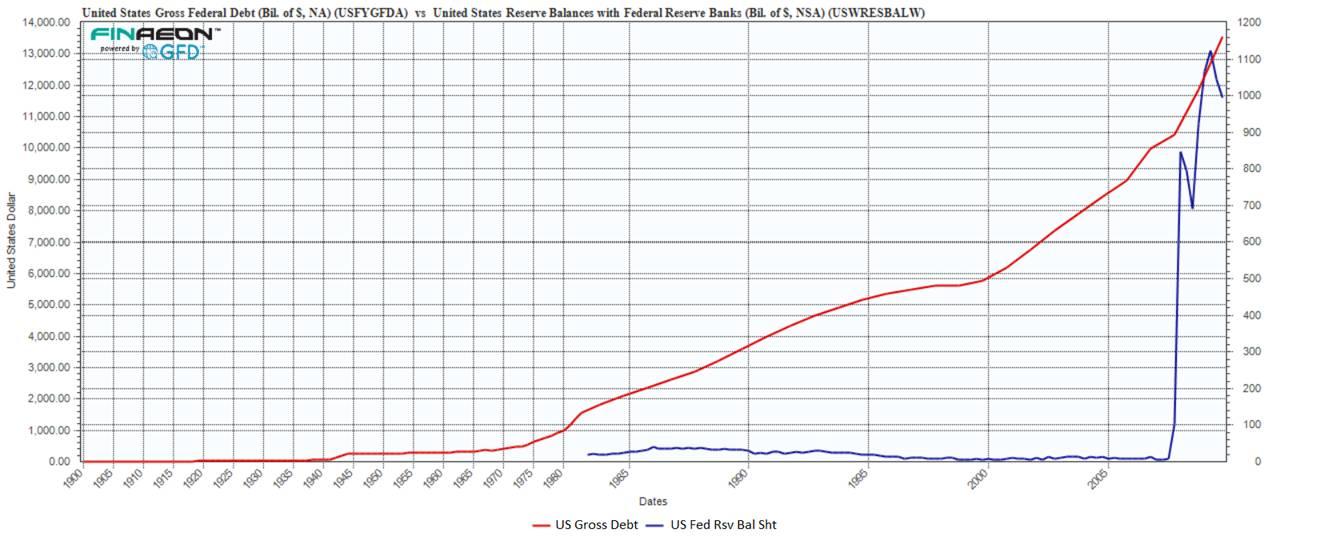
The policy and market response
What has happened since then? The federal deficit has soared and so has the Fed's balance sheet. The chart below from Global Financial Data shows the policy response:


What about the market response? The USD didn't plummet in the wake of "unchecked greenback emissions", largely because of the global nature of the financial crisis. Other major industrialized countries (and the eurozone in particular) experienced their own financial crisis and global central bankers went into crisis mode. The balance sheets of the ECB, BoE, BoJ and other central banks expanded to stratospheric levels in response. In that case, shouldn't the effects show up in inflation rather than then the exchange rate? Inflation, as measured by the CPI, has been extremely tame. What about commodity inflation? Shouldn't it show up as commodity inflation? Well, sort of. As the chart below shows, commodity prices (in black) did rise in the wake of the global financial crisis, but so did stock prices (in red). Commodity prices peaked out in early 2011, but stock prices have continued to advance.


Where's the inflation?


Inflation has been dormant
Perhaps the forecasters are early. Some analysts, such as David Rosenberg, believe that stagflation lies in our future:
You cannot keep real short-term rates negative for this long in the face of even modestly positive real economic growth without generating financial excesses today and inflationary pressures in the future. That’s why I continue to believe that the next major theme — and the legacy of the Ben Bernanke regime — will be stagflation.
Warren Buffett expressed his concerns about stagflation back in 2008, according to Bloomberg:
``We're right in the middle of it right now,'' said Buffett, chairman of Omaha, Nebraska-based Berkshire Hathaway Inc., in an interview on Bloomberg Television today. ``I think the `flation' part will heat up and I think the `stag' part will get worse.''
Though he was uncertain about its timing:
``It's not going to be tomorrow, it's not going to be next month, and may not even be next year,'' said Buffett, 77.
Stagflation involves two elements, slow growth and inflation. I understand the slow growth part of the stagflation forecast. The growth path of the American economy remains anemic, largely because this is not the typical recovery from an inventory recession, but a balance sheet recession that requires the deleveraging of household, corporate and government balance sheets. That process takes time.

I am not sure I get the inflation part of the forecast. Today, five years after the Lehman Crisis, we have see little signs of consumer price inflation and asset inflation, in the form of commodity price inflation, remains relatively tame. How long do we have to wait?


Is inflation purely a monetary phenomena?
It sounds like that that the model underlying the thinking of people like Rosenberg and Buffett is Milton Friedman's MV=PQ conceptual framework:

Where

M\, is the total amount of money in circulation on average in an economy during the period, say a year.
V_T\, is the transactions velocity of money, that is the average frequency across all transactions with which a unit of money is spent. This reflects availability of financial institutions, economic variables, and choices made as to how fast people turn over their money.
p_i\, and q_i\, are the price and quantity of the i-th transaction.
\mathbf{p} is a column vector of the p_i\,, and the superscript T is the transpose operator.
\mathbf{q} is a column vector of the q_i\,.


If you were to increase the money supply by expanding the Fed balance sheet, holding V (velocity) and Q (quantity produced in the economy) constant, price rises and you get inflation. That's why, it is said, that inflation is a monetary phenomena.

So far, despite the Fed's efforts to expand the monetary base, velocity has collapsed and we have seen little signs of inflation.


A demographic explanation
To resolve this conundrum, it might be useful to study the last episode of stagflation. Steve Randy Waldman recently proposed an alternative explanation of the stagflation of the 1970's based on age demographics, namely that stagflation was the result of stagnant productivity, not just money printing. Consider the chart below of US productivity. It was stagnant during the 1970's but it has soared to new highs in the current post-Lehman Crisis period.


Waldman wrote:
The “malaise” of the 1970s was not a problem with GDP growth. NGDP growth was off the charts (more on that below). But real GDP growth was strong as well, clocking in at 38%, compared to only 35% in the 1980s, 39% in the 1990s, and an abysmal 16% in the 2000s.

What was stagnant in the 1970s was productivity, which puts hours worked beneath GDP in the denominator. Boomers’ headlong rush into the labor force created a strong arithmetic headwind for productivity stats.
Simply put, there were too many Baby Boomers entering the workforce at that time and productivity lagged as a result:
The root cause of the high-misery-index 1970s was demographics, plain and simple. The deep capital stock of the economy — including fixed capital, organizational capital, and what Arnold Kling describes as “patterns of sustainable specialization and trade” — was simply unprepared for the firehose of new workers. The nation faced a simple choice: employ them, and accept a lower rate of production per worker, or insist on continued productivity growth and tolerate high unemployment. Wisely, I think, we prioritized employment. But there was a bottleneck on the supply-side of the economy. Employed people expect to enjoy increased consumption for their labors, and so put pressure on demand in real terms. The result was high inflation, and would have been under any scenario that absorbed the men, and the women, of the baby boom in so short a period of time. Ultimately, the 1970s were a success story, albeit an uncomfortable success story. Going Volcker in 1973 would not have worked, except with intolerable rates of unemployment and undesirable discouragement of labor force entry. By the early 1980s, the goat was mostly through the snake, so a quick reset of expectations was effective.
Policy makers, in effect, wanted to avoid more social tensions and unrest (remember the anti-Vietnam sentiment of the early 1970's) and paid the price in the form of slow growth and rising inflation. Karl Smith, writing in Forbes, quoted Arthur Burns in justifying the high inflation of the 1970's:
“Viewed in the abstract the Federal Reserve System had the power to abort the inflation in its incipient stage fifteen years ago or at any later point, and it has the power to end it today. At any time during that period, it could have restricted the money supply and created sufficient strains in financial and industrial markets to terminate inflation with little delay. It did no do so because the Federal Reserve was itself caught up in the philosophic and political currents that were transforming American life and culture.
Smith went on:
Put another way, high inflation can always be prevented if one is willing to tolerate recessions. Yet, recessions have consequences. Government budgets – at minimum – are redirected towards immediate relief, if not outright cut. Public investments in basic research, exploration and state-of-the-art infrastructure are postponed. In the private sector R&D budgets are slashed and new products put on hold. Small businesses, especially young start-ups, perish en masse. Families who are just beginning to climb the socioeconomic ladder and offer a better future to their children are knocked back down. Social tensions rise. Xenophobic and ethnocentric movements flourish. The adolescent generation, just on its way to the workforce, is permanently marred by a shortage of training and experience.
If demographics was the main cause of the stagflation of the 1970's, then stagflation may not be in our immediate future. In fact, a paper by IMF economist Patrick Imam (via Business Insider) suggests that an aging population is likely to make monetary policy less effective. Michael Mandel wrote a paper suggesting that productivity growth is likely to skyrocket in the near future because of technological innovations. As well, Izabella Kamanska chimed in and wrote on the likely deflationary effects of a global population peak.


Investment implications
Who is right? David Rosenberg and Warren Buffett in forecasting stagflation, or at least, rising inflation in our future? Or the likes of Waldman, who proposed a demographic and productivity explanation of the stagflation of the 1970's, whose implication is that rising productivity will act to contain inflation?

For policy makers, it presents a conundrum. Who do you believe? Policy makers have a much more difficult problem because policy is dependent on the underlying model of how the economy works.

For investors, the conundrum can be resolved easily because they don't have to adhere to any single point of view. The answer is model diversification.

I honestly don't know who is right. However, my inner investor believes that he should stay flexible and create a portfolio that diversifies between models.

For me, my investment lesson learned in the aftermath of the Lehman Crisis is not to be overly dogmatic about your economic and political beliefs. Stay flexible and learn to diversify your models.


Cam Hui is a portfolio manager at Qwest Investment Fund Management Ltd. (“Qwest”). The opinions and any recommendations expressed in the blog are those of the author and do not reflect the opinions and recommendations of Qwest. Qwest reviews Mr. Hui’s blog to ensure it is connected with Mr. Hui’s obligation to deal fairly, honestly and in good faith with the blog’s readers.”

None of the information or opinions expressed in this blog constitutes a solicitation for the purchase or sale of any security or other instrument. Nothing in this blog constitutes investment advice and any recommendations that may be contained herein have not been based upon a consideration of the investment objectives, financial situation or particular needs of any specific recipient. Any purchase or sale activity in any securities or other instrument should be based upon your own analysis and conclusions. Past performance is not indicative of future results. Either Qwest or I may hold or control long or short positions in the securities or instruments mentioned.